Blog

Corridor Conversations: an interview with Parvathi Prasad

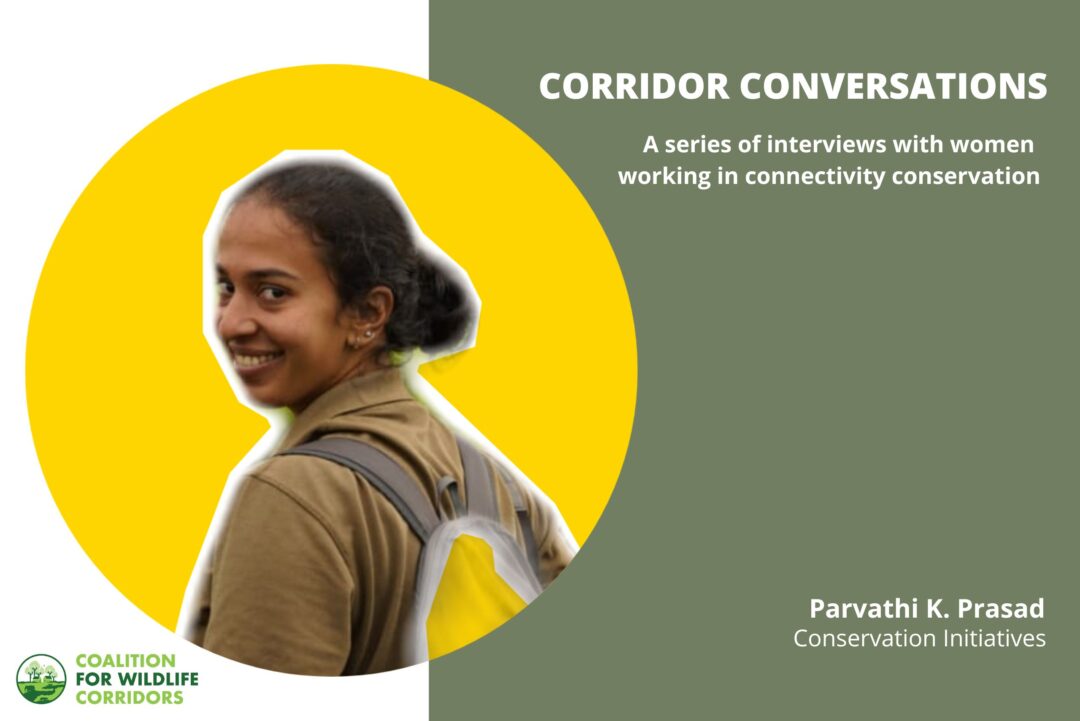
An Interview with Parvathi K. Prasad

© PRASENJEET YADAV

Welcome back to Corridor Conversations, and the next interview in our series on women working in connectivity conservation.

Today, Harshad Sambamurthy speaks with Parvathi K. Prasad, Research Affiliate with Conservation Initiatives.
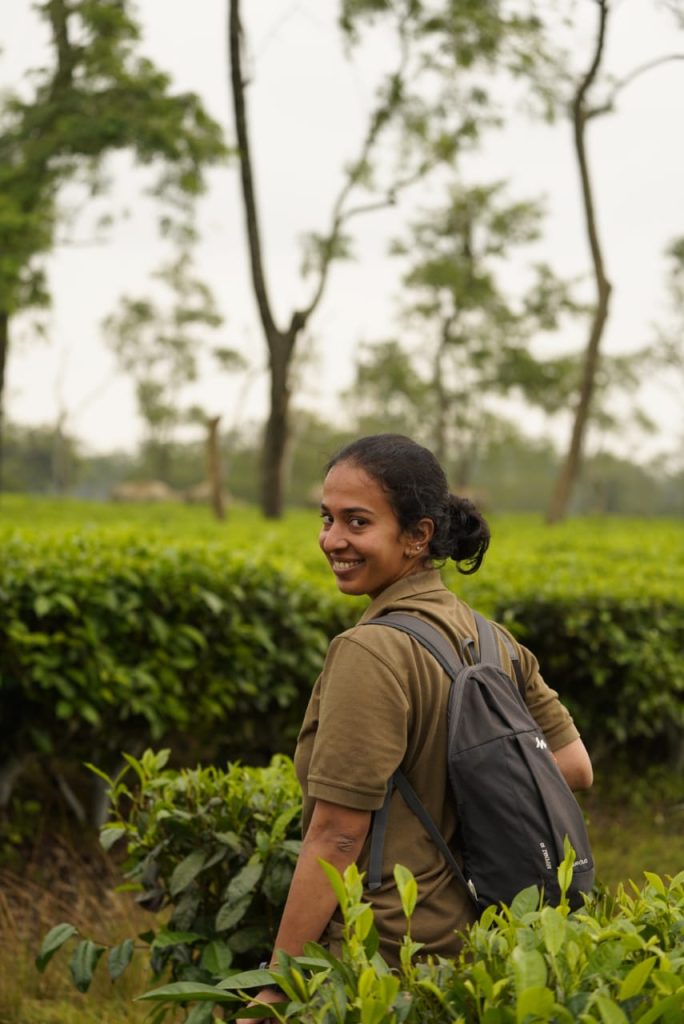
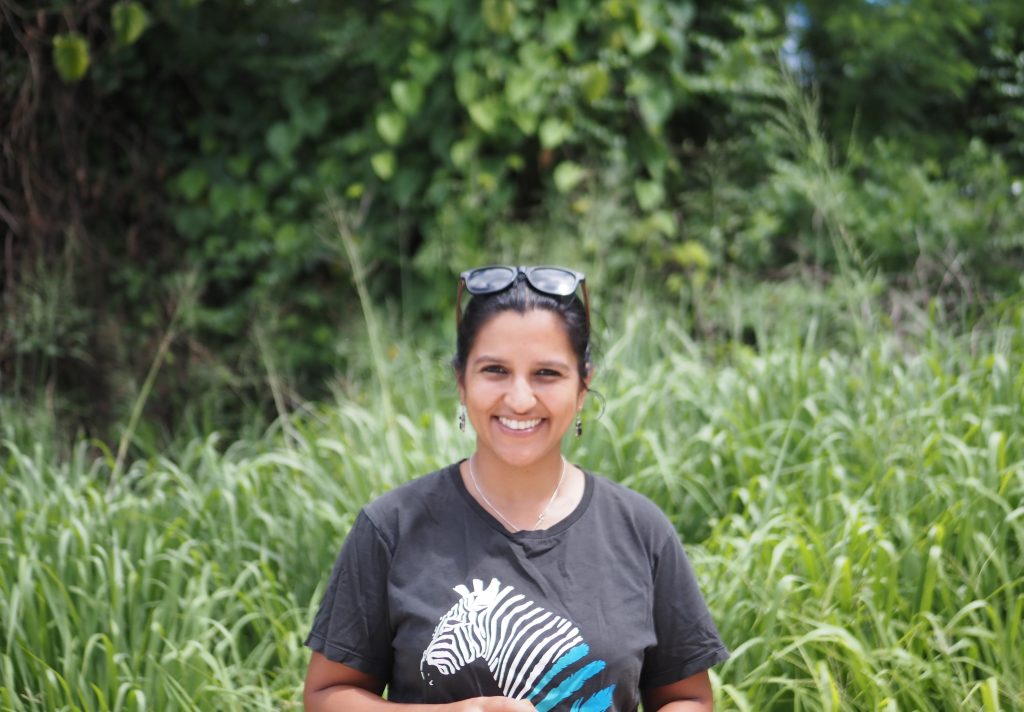
Parvathi K. Prasad (Image Credit: Pranav Vajapeyam)

How has your journey in conservation been thus far? What drew you to this field?

My interest in wildlife began at a young age. My father was, and continues to be interested in wildlife. As a result, almost all of our family trips during my school days were to Karnataka’s protected areas. I loved being around and watching wildlife! The idea of doing something more about my interest in wildlife came about much later.

For my BSc, I studied Biotechnology; but it was during my BSc days that I learnt of Masters courses in Wildlife Biology, and increasingly found myself drawn towards a career in wildlife. I took up some short-term volunteering opportunities that allowed me to experience the forests of Karnataka on foot for the first time. It was wonderful! Following my BSc, I took some time off of academics to work at Centre for Wildlife Studies, Bangalore. I was part of a research project that examined human–wildlife interactions around those very forests that had instilled in me a love for wildlife. It was my first experience with a research project, and the first time I engaged with local communities’ perception of, and experiences with wildlife—it taught me much.

Following a Masters in wildlife biology, I have been working in Assam’s Kaziranga–Karbi Anglong landscape—an amazing landscape that is seasonally dynamic and is home to rich biodiversity. Kaziranga is also an extremely interesting system to study elephant ecology and human–elephant interactions—the focus of my work at Conservation Initiatives, as well as my ongoing PhD at Deakin University. Working here has taught me what it takes to work in a landscape long-term, and the value of doing so.

While the journey in this field so far has been fun and exciting for the most part, I have had my share of self-doubt and low confidence. Fortunately, I work with great mentors—Dr. Varun R. Goswami and Dr. Divya Vasudev—who encourage me to push my limits and instil confidence in me.

Have you faced challenges as a woman working in conservation? What are some of the stereotypes you have had to fight against/ negotiate?

To be honest, I have been lucky in this regard; being a woman in this field has not been greatly challenging for me. During the course of this journey, there may have been a few instances of restrictions with regards to field work or individuals not taking me seriously, but mostly, my experience has been positive. Mentors and colleagues have been supportive, respectful and have always made me feel secure.

What motivates you, as you continue to contribute to this field of work?

Conservation, or even just concern for the natural world, can often make you feel disheartened and generally negative, but there is also much to look forward to. I think exciting research and conservation success stories from around the world keep me motivated. It is encouraging to see research translating into policy or conservation actions, and to know that efforts have paid off.

I also think that building conservation awareness and interest in people is extremely important. With that in mind, I feel motivated each time I get someone interested in wildlife, or when research findings and conservation messages reach people—whether it is through one-on-one interactions, social media or engagement with local communities.

Lastly, and most importantly, I think wildlife itself is the biggest motivating factor. Sometimes, it is easy to get lost in the day-to-day tasks and lose perspective of what drives us. In such times, spending some time just observing and appreciating wildlife reminds me of why I am here.
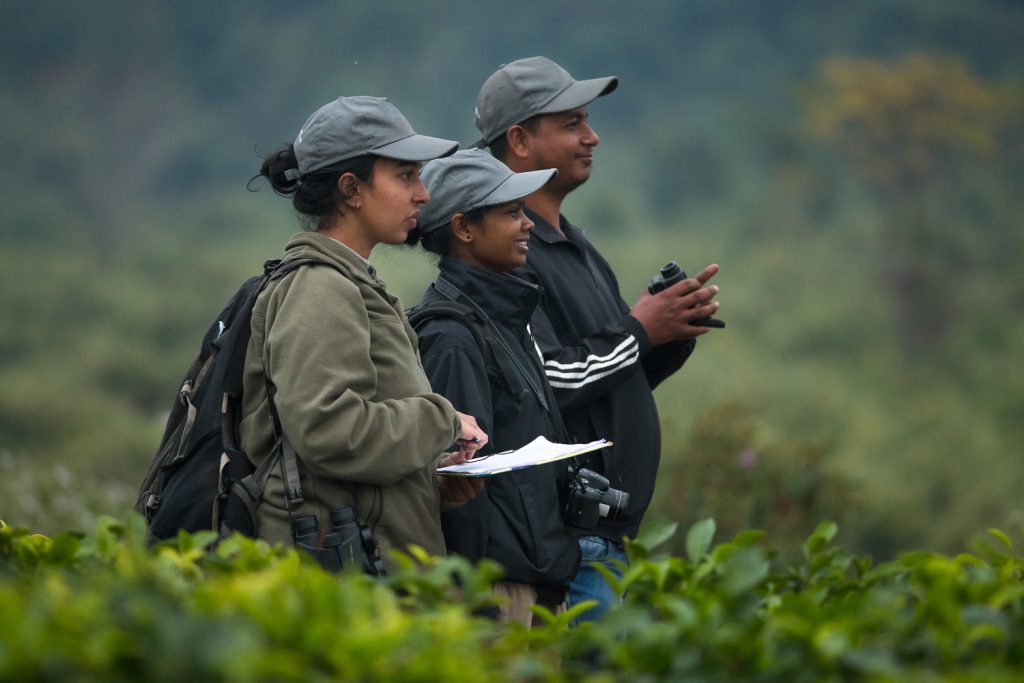
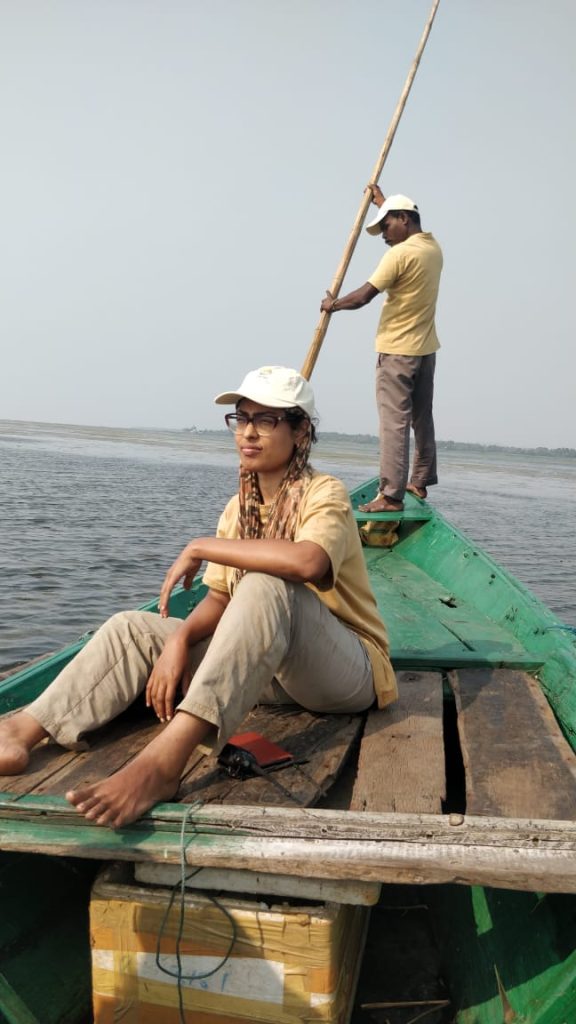
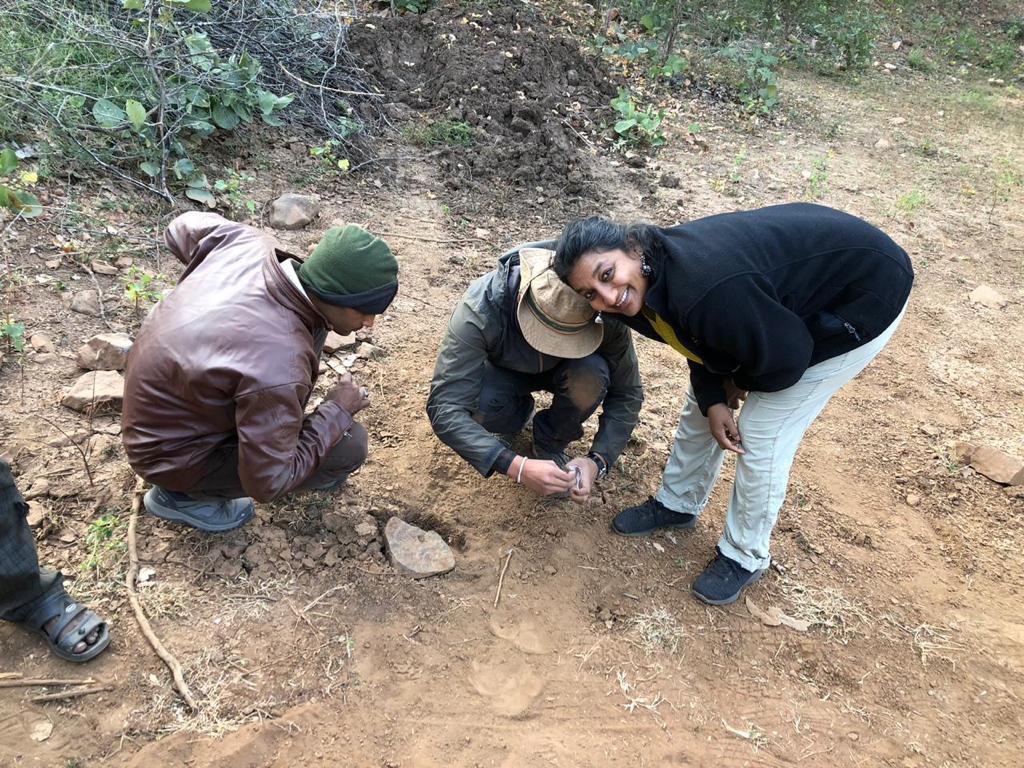
During a field survey (Image Credit: Varun R. Goswami)

In the landscapes you have worked in, what are some of the similarities (or differences) you have observed in how communities perceive wildlife, and the shared spaces they call home?

I have, so far, worked in Karnataka’s Western Ghats and the Kaziranga–Karbi Anglong landscape in Assam. In both regions, there is reverence, tolerance and value for wildlife—one of the main reasons for India to host vast biodiversity alongside high densities of people. In both places, I think that people are empathetic towards animals’ resource needs and understand that loss of habitat is a threat to animals.

Positive perceptions, however, do not always translate into favourable actions or behaviours—there are several factors that influence how human–wildlife interactions play out on ground. This is one of the key challenges in managing human–wildlife interactions, and where the need and opportunity for conservation arise. As an example, while people in the Kaziranga landscape generally revere and admire elephants, teasing and chasing of elephants also occur. The same is true of human–wildlife interactions in Karnataka.

Despite evidence of several species using forest-agriculture mosaics as corridors, the popular definition of corridors is still ‘linear, narrow, natural habitat linkages that allow movement’. While forested corridors are important, what does your work on elephants tell us about how they move through and use human-modified spaces?

Research carried out by seniors and colleagues at Conservation Initiatives on elephants shows that elephant movement is not restricted to forested corridors; animals move through human-use areas such as tea plantations, particularly in the monsoon to seek refuge from flooding of the river Brahmaputra. Animals’ ability to move through areas such as tea estates is important because tea estates are widespread in the Kaziranga landscape (as well as in other parts of Assam and West Bengal), and animal movement through such areas can be crucial for maintaining landscape connectivity. The same maybe true of human-use areas in other landscapes and for other species.

Human–wildlife interactions can influence animals’ ability to move through human-use areas. One important factor that affect animal movement in human-use areas is human behaviour itself, i.e., how people respond to elephants can affect how and where elephants move. This is one component of my on-going PhD research—to examine how human behaviour impacts elephant movement in tea estates and surrounding areas in the Kaziranga landscape.

As you seek to secure elephants in a large, heterogenous landscape that includes Kaziranga National Park and Tiger Reserve and the neighbouring tea estates, how have you navigated working with a diverse set of stakeholders (i.e. from Government officials, tea garden management, local ethnic communities, as well as communities that work in the tea estates, etc)? Has being a woman made it easier or more difficult to work with some of these stakeholders?

Fortunately, my experiences with stakeholders in this landscape—Government officials, local communities, and tea estate management—has been pleasant. People I have interacted with have been respectful, and I have not really felt that I am at a disadvantage because of my gender. Here, I will also give due credit to my team at Conservation Initiatives—having members from the local communities on the team makes it a lot easier to initiate interactions with local stakeholders and address issues that may arise. I also think that learning to speak the local language helps—I am not originally from Assam, and people appreciate that I try.

Tea-gardens can be a hotspot for conflict. Are there specific times of the year, or parts of the mosaic landscape where conflict is especially high? What have you found to be the most effective conflict-mitigation strategies?

In this landscape, elephants generally use tea estates throughout the year, but human–elephant interactions peak in the Winter months (Oct–Dec) because it is the paddy-growing season. Elephants enter paddy fields to consume crops, but to access the fields, they need to move through tea estates that are situated in the intervening space, and therefore, the frequency of interaction with people in tea estates increases.

While elephants consume paddy, they do not eat tea leaves and financial loss in tea estates in minimal. However, people—youth in particular—chase elephants in tea estates. This is not the same as people guarding crops, and such interactions have the potential to endanger both elephant and human lives. Mitigating this form of conflict needs a change in people’s behaviours towards elephants. While we (Conservation Initiatives) are engaging with the youth to bring about conservation awareness and interest, the process will take time and requires our long-term engagement with the community.

Another concern in the tea estates is that of human safety where people live—clusters of houses called labour lines within large tea estates. Sometimes, elephants move close to labour lines at night, or during the early hours of the morning, and if people cannot detect elephants from afar, there is potential for accidental encounters. Our past research highlighted the need to address this concern, and so, our team installed solar lights around labour lines in 10 tea estates, where both elephant and human activity was high. This measure received positive responses from the tea community. But more broadly speaking, I think suitable measures may vary with the context of human–wildlife interactions.
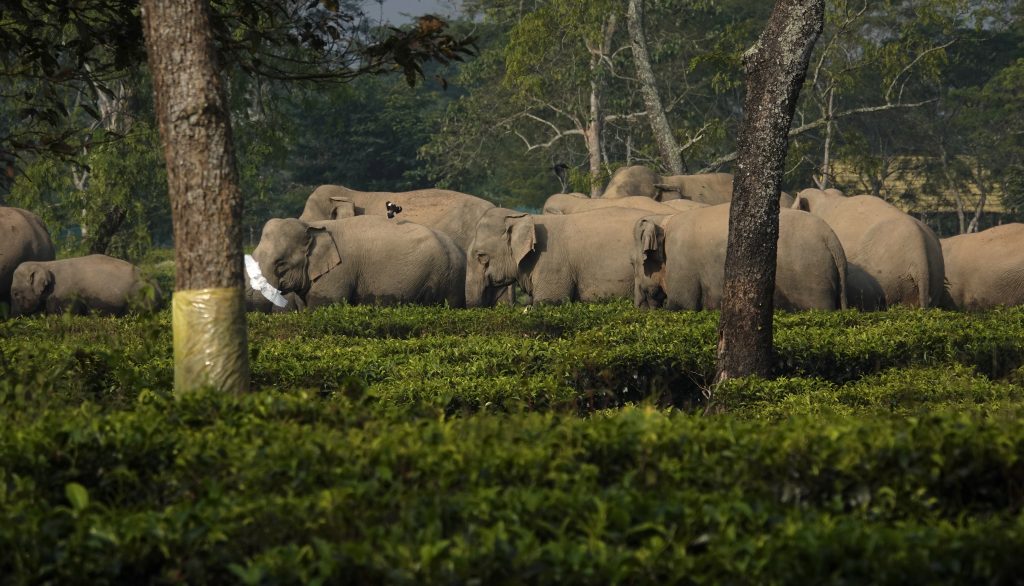
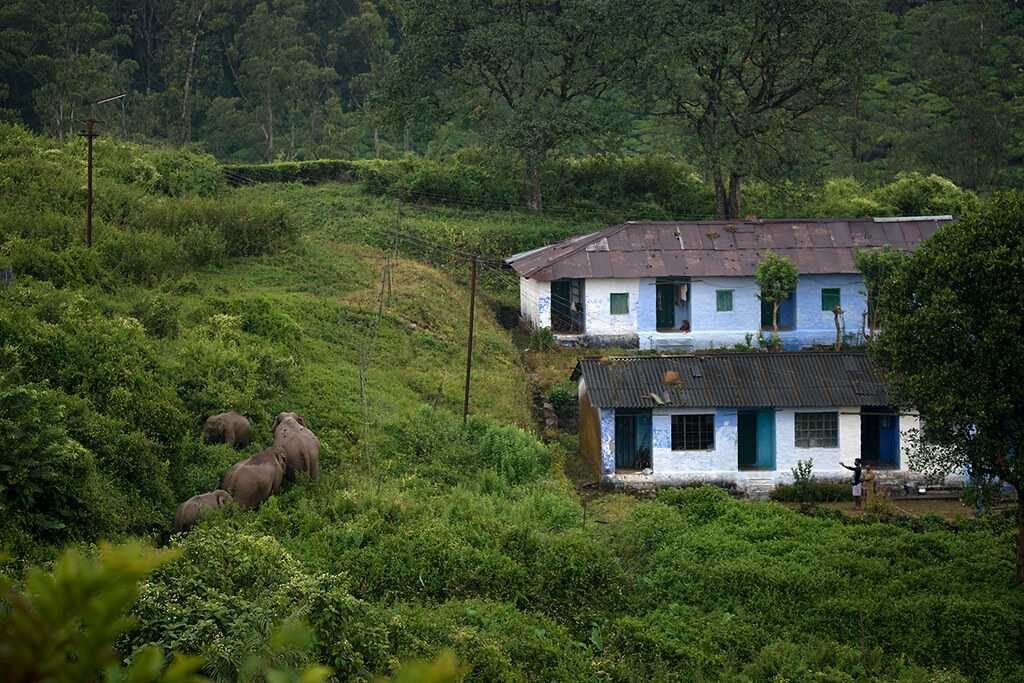
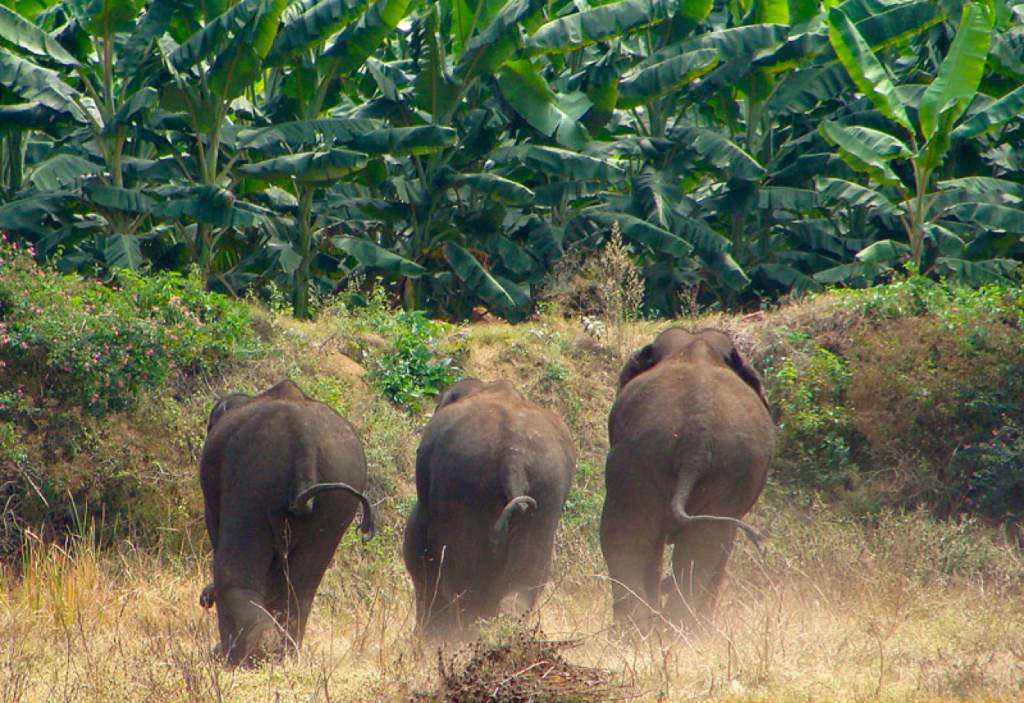
A herd of elephants moving through a tea estate in Assam (Image Credit: Parvathi K. Prasad)

Can eco-tourism play a role in strengthening community livelihoods in heterogenous landscapes surrounding protected areas and along corridors? Do you have any examples you would like to share? Might eco-tourism also serve to drive home the economic benefit of their conservation at the policy level?

I definitely think that ecotourism has the potential to strengthen community livelihoods and build support for conservation of species if it engages local communities and is practiced in a sustainable manner. I personally have little experience in this regard, but Kaziranga National Park is one example where tourism builds support for conservation. The National Park’s tourism sector employs a lot of local people—as gypsy drivers/owners, in restaurants and hotels, etc. As a result, there is support for conservation in the area. During the flood season every year, local communities support the Forest Department in rescue and treatment of injured animals. This overall support and awareness also reflects in people’s responses towards animals, including elephants in tea estates and other human-use areas—areas closer to the National Park, in my opinion, are a lot more positive in their interactions with wildlife than other parts of the landscape.

Several corridors in India are mosaics of fragmented forests, plantations and agriculture. From your work in these multi-use spaces, do you get a sense that the importance of these mosaics for connectivity is recognised by the stakeholders?

I think this may vary from place to place, with factors such as land use type and nature of animal movement. Kaziranga, for example, is a floodplain ecosystem. As mentioned, Brahmaputra floods annually, inundating large parts of Kaziranga National Park and animals move out of the National Park and move through human-use areas. The need for this flood-driven movement of animals through multi-use spaces is well understood by local stakeholders. They also understand that elephants move between forest fragments through such spaces; but, I am not so sure if they fully understand the importance of multi-use spaces in enabling movement and contributing to connectivity.

What are the foreseeable challenges in maintaining habitat connectivity? Realistically speaking, can they be maintained in the long-term, or is the arm of socio-economic development bound to cut through this longevity?

I think both infrastructural development and human–wildlife conflict are considerable challenges to habitat connectivity. That infrastructure development can hamper connectivity has been known for a while, but the latter is only now being recognised and studied. But knowledge aside, I don’t think connectivity features sufficiently in planning for conservation and development in India. Ensuring connectivity in today’s rapidly changing world will become increasingly harder I think, but I am still hopeful that with more research, communication and stakeholder engagement, connectivity will become an integral part of conservation planning.

How can we map wildlife connectivity in a future that is likely to have more humans, and therefore more human-wildlife interactions? Is that a disaster waiting to happen or a global case-study in co-existence?

Recent studies (Ghoddhousi et al., 2021 and Vasudev et al., 2022 for example) have brought to the fore the need to incorporate human behaviours and human–wildlife interactions into connectivity studies. Moving forward, more research in this space is needed to map connectivity and prioritise areas for connectivity. While it will be extremely challenging, I am hopeful that we can develop means to put it into action.
Corridor Conversations: an interview with Tiasa Adhya

An Interview with Tiasa Adhya

© PRASENJEET YADAV

Welcome back to Corridor Conversations, and the next interview in our series on women working in connectivity conservation.

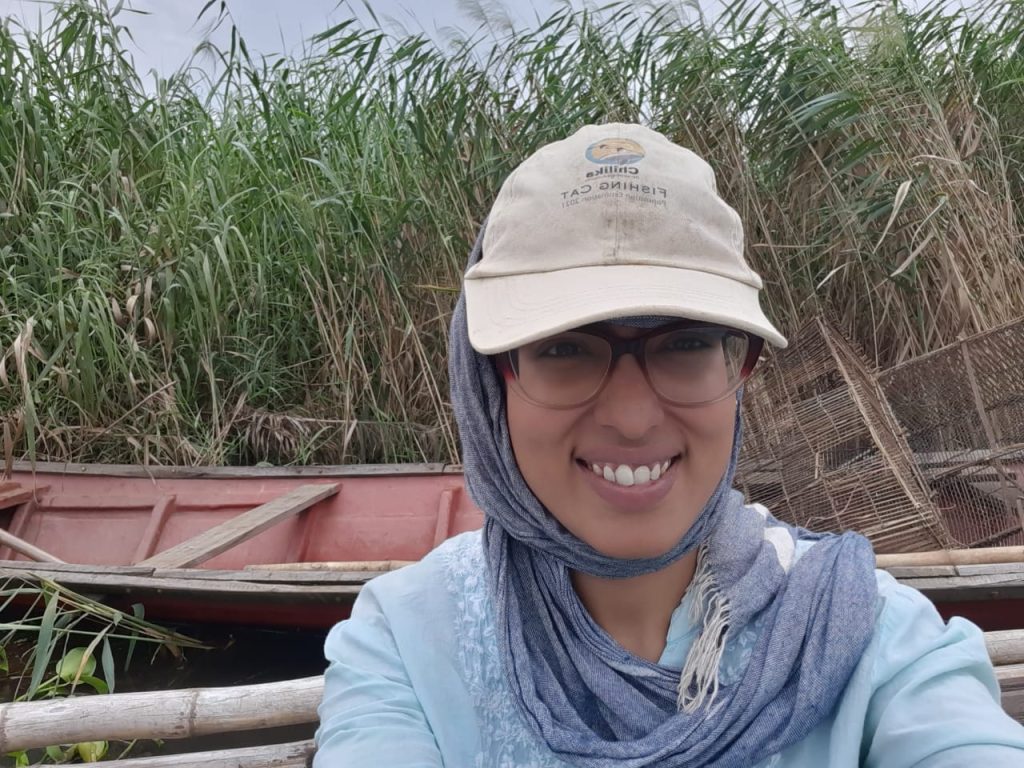
Today, Harshad Sambamurthy speaks with Tiasa Adhya, Co-Founder – The Fishing Cat Project

Tiasa Adhya

How has your journey in conservation been thus far? What drew you to this field?

It has been a journey of ups and downs and a journey that tests resilience.

I cannot particularly pin it down to a moment, (i.e., what drew me to this field). I do understand that my father’s love for nature got imprinted on me from a very young age. So, naturally as I grew up, the seeds of love continued to grow inside. Being a city kid, my neighbourhood lacked backyard ponds and even a playing ground but our alley happened and still happens to be the only non-concretised one in the neighbourhood. The trees and gardens in the surrounding plots were rapidly cut down and replaced by buildings while the trees in our alley stand tall even today. These trees along with books and films on wildlife that my father introduced me to kept nourishing a very strong love for nature in me and I wanted to do something to aid in the persistence of threatened wildlife.

Have you faced challenges as a woman working in conservation? What are some of the stereotypes you have had to fight against/ negotiate?

Of course I have. From sexual harassments to getting victim shamed – in short, what many women face in various sections of society working in various types of field.

I worked in one of the biggest wildlife organisations in Bengal as a fresher. Danone Fund for Nature funds this organisation for carbon credit projects. I was the field person who took the funding agency to the Sundarbans on their first field visit – sort of the field visit based on which the agency chose to work with this organisation. The representatives who came from the funding agency were French. They were very friendly and one of them started teaching me French words. When we were returning, he slipped a note into my hand which read “This is my room number. Let’s have some fun tonight.” I was dumbfounded of course and took the note to show it to the lady in the NGO who was the Project Director. In her college days, she was the first woman General Secretary of the student’s body of one of the best colleges in Kolkata; Presidency College. She was a popular leftist student leader and a shining beacon for the women in her college. So, automatically, I was expecting a just reaction from her. Not only did she do nothing and not speak a single word about the incident to the funders, but also told me that I should cover myself up more in the field, which happened to be the sweaty, muddy terrain of Sundarbans. While I can laugh at the hypocrisy now, I am angered by the several cases of sexual misconduct and harassment that is happening to women in wildlife. To all those who have had similar experiences, I urge them to speak up publicly about such incidents. There cannot be a negotiation with such forms of oppression, we need to fight and defeat it as the only long term solution.

Apart from this, I met a lot of the older men in this field as a budding wildlifer. These men were engrossed with the idea that wildlife and wild places were domains of masculine and macho men. They tried to make me understand that women were too fragile. Thirteen years down the line I would be glad to have a conversation with these men again but I do not think they would dare speak their minds anymore, that is, if they have not changed themselves already.

Thirdly, often it is easy for men to befriend poachers and work as on ground informants since they can light a bidi together or drink alcohol together – all well-known tools to bond socially. But I cannot do so as a woman. Everyone knows why. I have to be the quintessential daughter or sister, never a friend. This is something that is a hindrance, a constant irritant. The root of it lies in patriarchy. It’s well past time now. Threatened wildlife and patriarchy needs role reversal, patriarchy needs to go extinct.

What are some valuable lessons you’ve learnt that could benefit early-career women conservationists?

    If you face sexual harassment in any organisation, let your close colleagues know about it, write an official mail without fearing consequences, file a police complaint, post in social media tagging prominent people, portals in the field as well as the National Women’s Commission and the Ministry of Women and Child Development.

    On a different note, we would benefit if we moved away from using sanitary napkins towards menstrual cups. Not only does it significantly reduce our plastic footprint, menstrual cups maintain comfort levels in the field big-time.

    Pertaining specifically to the field of conservation, I feel that my management skills improved a lot because I have mostly worked outside protected areas. Often, as students of wildlife, we work majorly inside protected areas, with the Forest Department as the only stakeholder. However, working outside protected areas, really trains one in dealing with multiple stakeholders. Cultivating this skill is crucial for any conservation practitioner as conservation needs to have a landscape-level approach.

    Do not romanticize local communities and see local community conservation as a one stop solution for all conservation problems.

    It is good to be aware of the fact that conservation is a continuous process that requires engagement, presence and innovation throughout. What works today and here might not work tomorrow and/or there.

    Believe in yourself, in your abilities and in your dreams.

    In some of the landscapes you have worked in, what are some of the similarities (or differences) you have observed in how local communities perceive wildlife, and the shared spaces they call home?

    There is a lot of variation in how local residents perceive wildlife and their inter-relationships throughout and it is a good exercise to think why in certain places there is more tolerance or why certain wild animals are just tolerated more.

    For instance, in human-dominated landscapes of southern Bengal, where I am working on Fishing Cat conservation, I feel that people have very little tolerance to wildlife in general and Fishing Cats in particular. In comparison, I observe that people in Chilika (in Odisha) do not bother about Fishing Cats.

    If we delve deeper, we would see that in the Bengal landscape, Fishing Cats prey upon fishes from private ponds. This means that people incur a loss when Fishing Cats prey on fish that people spend time and money cultivating. However, Chilika belongs to everyone and no one. It is a huge lagoon and the largest in Asia with a high fish abundance. Therefore, if Fishing Cats fish from the lagoon, no human incurs a loss and therefore animosity does not colour human-Fishing Cat interactions. My understanding is that the more private our resources become, the more defined our perception of loss and more likely that the wildlife with which we share our resources with would be vulnerable in such shared spaces. On the contrary, the more communal and vast our natural resources are, the more likely wildlife will be tolerated by local residents.

    The similarity across landscapes I have seen is the erosion of existing and cultural tolerance towards wild animals and a younger generation among the rural populace who are losing touch with their traditional ecological knowledge systems and pursuing urban aspirations.

    In the field, conducting a survey (Credit: Tiasa Adhya)

    Are there any interesting myths or stories from folklore that can better inform us about the cultural heritage and symbolic associations of the fishing cat?

    Think of Fishing Cats as the representative of a marginal community. A marginal community stays outside the mainstream consciousness. So are wetlands. People and policy makers generally think of wetlands to be plain waterbodies. They are generally oblivious to the fact that wetlands can completely dry up during the summer and flood during the winter. Moreover, society and policies see wetlands as water logged, and mosquito-infested wastelands. On the contrary, human communities that are strictly dependent on wetlands see them as homes. Unfortunately, the representation of such communities are minimal in mainstream literature and arts. Therefore, the Fishing Cat does not have any heritage tag or symbolic cultural associations.

    However, the Angkor Vat temple complex in Cambodia has an outstanding story to tell in this context. Engraved onto this world heritage site is the figure of a short legged and short tailed cat with blotches swimming among a school of fishes – small and big. Unmistakably, it’s a Fishing Cat. This temple complex; built on the floodplains of the mighty Mekong demonstrates how an ancient civilization which once thrived at the same place regularly interacted with this cat. In this context, then the Fishing Cat is symbolic to a time of thriving floodplains that sustained human civilisations.

    Many a time, media coverage focuses on large mammals traversing fragmented habitat. And habitat fragmentation is the primary threat impacting fishing cats as well. How can we highlight the importance of connectivity for fishing cats in particular, and small cats in general?

    Rather than small cats, I would suggest that we view Fishing Cats as a member of the wetland ecological community. This is because small cats occupy various types of niches and exhibit differential levels of tolerance towards anthropogenic modifications. It would be difficult to understand how fragmentation affects Fishing Cats from the perspective of small cats. However, if we try to understand Fishing Cat connectivity from the perspective of degrading and rapidly disappearing wet landscapes, it would make much more sense. Fishing Cats; being carnivores, and belonging to the charismatic felid community, is capable of garnering crowd support and much needed attention on wetland connectivity issues. Conversely, we have a strong wetland law and excellent guidelines from the Ministry, which, if followed in letter and spirit, would work wonders for Fishing Cat conservation. Thus, more awareness and education among urban communities who are likely to have more powerful voices is needed to engender support and powerful advocacy campaigns for wetland and Fishing Cat connectivity.

    Linear infrastructure can often lead to instances of roadkill. While mitigation measures focussed on large mammals are being incorporated in some places, are they likely to be effective for smaller species as well? What are some of the specific considerations for small cats/ fishing cats that need to be considered for such mitigation to be effective?

    It might. We do not know. However, our mitigation measures focused on mega carnivores might be concentrated near protected areas, which might benefit Fishing Cats but will certainly not be enough. More than 90% of Fishing Cat distribution is present outside protected areas in human-dominated landscapes. Most of these areas are located in densely areas with high human populations. Tackling road kill incidents throughout the Fishing Cat range presents a difficult frontier for conservationists. We could cordon off both sides of roads by putting nets, and keep some portions open. In these portions we need to introduce bumpers and speed meters to check the speed of cars. Proper sign boards should be put up in these sections with information on the threatened status of wildlife and an appeal to drivers to slow down their cars.

    What are the foreseeable challenges in maintaining habitat connectivity? Realistically speaking, can they be maintained in the long-term, or is the arm of socio-economic development bound to cut through this longevity?

    If it is business-as-usual, we know what the answer would be. However, as a conservationist, I believe we should speak against business-as-usual. Wetlands are categorised as ‘wastelands’ under land use policies and this gives more power to socio-economic development to convert these dynamic and life-sustaining ecosystems. We must be vocal and see to it that the Indian wetland protection laws be implemented in letter and spirit. If we are able to unite our efforts and raise the decibel for wetland advocacy, we might just control the urge to accept

    What have been some of your accomplishments with regards to fishing cat conservation? The challenges? Bringing this small cat to the forefront of wetland conservation?

    Partha Dey, (my colleague), and I, co-founded The Fishing Cat Project (TFCP) in 2010. We started working in West Bengal where the Fishing Cat is the State Animal. However, awareness on the Fishing Cat was minimal then. So much so that pictures of dead Fishing Cats used to be published in leading newspapers as ‘civet cats’. We thus began spreading awareness by involving multiple stakeholders – local residents, civil administration and policy makers, student communities as well as the media. One indicator that this approach has been successful is the accurate representation of the Fishing Cat in newspapers today. Additionally, there are more eyes and ears looking out for the Fishing Cat and taking up independent conservation ventures now than there ever was. Our data on the Fishing Cat’s presence in one of the largest wetland expanses outside protected areas in West Bengal contributed to a favourable order and a landmark judgement from the court. Due to this court order, all such wetlands outside protected areas can receive protection.

    India’s legal infrastructure is one of the strongest in the world when it comes to imparting protection to wetlands and also to wildlife. However, wildlife is the least of priorities, especially at present, and people know not what it means to destroy wetlands. Therefore, the challenge is to see to it that laws are properly implemented. Litigations are a good conservation tool to ensure proper implementation of our laws. However, these could become expensive affairs. I am still to see any funding agency that would fund litigations against the government. There is a lot of unnecessary emphasis on ‘community conservation’ as if that by itself will solve all conservation problems. These combined are some of the conservation challenges which many like me face.

    Secondly, our work in Chilika led to the adoption of the Fishing Cat as Chilika’s official ambassador – a declaration which came from the Chilika Development Authority, the guardian government body looking after the health and wellbeing of Chilika and our primary collaborator in that landscape. It then led to the first population estimation of the Fishing Cat in Chilika which was done completely in a human-dominated landscape by involving fishermen communities.

    One challenge of working with government officials is that implementation depends on the officer-in-charge. One can manage to form a good partnership with a good officer and work towards a good conservation plan. But then the officer is bound to get transferred and then the conservationist is back to square one wherein they will have to build a new partnership. In rare instances do these conservation plans get institutionalised (i.e., whoever is in charge will have to implement the conservation plan).

    How can we map wetland connectivity in a future that is likely to have more humans, and therefore more anthropogenic development and human-wildlife interactions? Is that a disaster waiting to happen or a global case-study in co-existence?

    If our policies are hell-bent on destroying wetlands, not only would it spell disaster for Fishing Cats but also us. Wetlands are our supermarkets, water reservoirs, purifiers, and carbon sinks. More ecologically unsound anthropogenic development would disrupt the ecological fabric that sustains both human communities and Fishing Cat populations, leading to decreasing resources and increasing conflict. I cannot imagine harmonious existence under such a scenario.

    However, all is not lost. We still have an opportunity to make it work for conservation and for our future. Wetlands are known to be integral to achieving globally accepted and recommended Sustainable Development Goals (SDGs).Therefore, wetlands have to be conserved by advocating for their value in maintaining both society and biodiversity.

    Two Roads Diverged In The Wood; Which One Will The Elephant Take?

    Two Roads Diverged In The Wood; Which One Will The Elephant Take?

    © PRASENJEET YADAV

    Advaith Jaikumar

    This piece is based on the following study:

    ​​Vasudev, D., Fletcher, R. J., Srinivas, N., Marx, A. J., & Goswami, V. R. (2022, December 27). Mapping the connectivity–conflict interface to inform conservation. Proceedings of the National Academy of Sciences, 120(1). https://doi.org/10.1073/pnas.2211482119

    Thumbnail image Credit: Ganesh Raghunathan

    Background

    India is home to a unique situation where high densities of people share spaces with wildlife, leading to frequent encounters. It is no surprise that we often come across news articles related to these interactions. Animals need to move between habitats to find resources for basic survival needs. This movement also promotes healthier populations by fostering genetic diversity. However, dispersing animals may come into conflict with people, leading to loss of lives and livestock, and agricultural damage. This may also result in retaliatory action, posing a threat to wildlife. Coexistence has become a primary concern and a goal for people working towards conservation as well as human well-being.

    In this context, how can wildlife connectivity and human-wildlife conflict be addressed simultaneously? A new paper by Divya Vasudev, Rob J Fletcher, Nishanth Srinivas, Andrew J Marx and Varun R Goswami introduces a framework that provides simultaneous perspectives of both sides of the paradox. The study, published in the Proceedings of the National Academy of Sciences (PNAS), predicts conflict hotspots and identifies location-specific strategies to minimise human-wildlife interactions and boost connectivity. The authors illustrated the framework using the endangered and wide-ranging Asian elephants in the Mysore Elephant Reserve (ER) as an example.

    Asian elephants are important species in the lens of connectivity conservation and conflict mitigation. The Mysore ER is a landscape characterised by a mix of protected areas, reserve forests, and agricultural settlements. It hosts the largest population of elephants in India and is a crucial conservation area with a history of negative human-elephant interactions.

    Two of the most common strategies used in the Mysore ER to deal with elephants that come into conflict while dispersing have included fencing and the removal of ‘problem’ elephants. However, while fencing may mitigate conflict, it does so at the expense of elephant dispersal through the landscape. Moreover, there have been reports of increased mortality risk of elephants trying to bypass fences. When it comes to the relocation of elephants, no example illustrates its inefficiency better than the Alur-Sakleshpur case. In 2014, the government relocated 22 elephants that were considered an isolated population. However, in less than a year, the area was recolonised by elephants. This indicates that the population was never isolated and further substantiates the need for conservation strategies tailored to the connectivity–conflict interface.

    Method

    To provide a solution, the authors developed a framework that derives from random-walk theory – a concept that models animal movement step-by-step and predicts the animals’ next step based on their previous location. They extended the random-walk theory using a mathematical framework called Markov chains. The spatial absorbing Markov chain (SAMC) framework accounts for movement behaviour, mortality risk, and potential conflict for animals that migrate through a landscape. To develop their framework, the researchers collected data from three key elephant populations in the Mysore Elephant Reserve, which served as the starting points for dispersal. They also interviewed locals to gather information on elephant activity and conflict. The interview data helped validate the framework and provided insights into how elephants use the landscape and the areas where conflict is most prevalent. Landscape resistance was shown to be determined by land use and human population density, wherein elephants avoided areas with high population density.

    Note: What is landscape resistance? Landscape resistance refers to the extent to which a location is difficult or easy for elephants to move through. Higher resistance values indicate that elephants are less likely to move through those areas and vice versa.

    Sites with coconut and areca nut plantations had higher conditional conflict than croplands and agroforest plantations, such as coffee, since elephants tended to avoid the latter two. The study also found that the risk of conflict when elephants moved through an area was slightly higher in regions with high densities of humans.

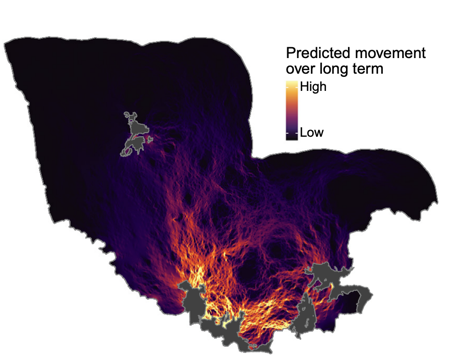
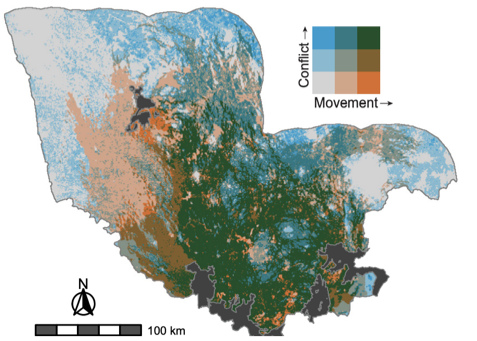
    Using this data, the authors created maps of “landscape resistance” (Map 1) that show where elephants are likely to move and “conditional conflict” maps (Map 2) that show where conflict is likely to occur if elephants use a particular location. Landscape resistance and conditional conflict in the Mysore ER was found to be positively correlated, suggesting that elephants avoided moving through areas with an increased risk of conflict.

    Application

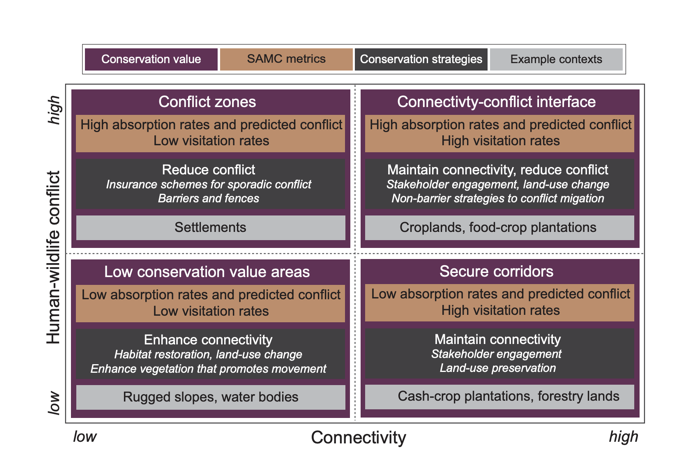
    The framework addresses the paradox of connectivity and conflict mitigation and helps identify areas where strategies for addressing both can work together. It does so by simplifying the identification of relevant conservation actions in areas depending on the risk of conflict between humans and wildlife. Based on their connectivity and conflict levels, the conservation landscapes are categorised into four scenarios:

    The locations of least conservation concern are those that play little or no role in connectivity and face minimal conflict. Here, conservation strategies could focus on habitat restoration, increasing woody vegetation and facilitating connectivity to encourage animal movement through these areas. Areas that allow connectivity and face minimal conflict have the highest potential for long-term conservation and human-wildlife coexistence.

    The framework also distinguishes between conflict hotspots with high and low visitation rates by wildlife, and different conservation strategies are needed for each. Insurance schemes or barriers restricting animal entry may suffice for hotspots with low visitation rates since conflict here is sporadic. For hotspots with high visitation rates or in the “connectivity-conflict interface”, deeper deliberation is needed to address conflict while allowing animal movement. Redirecting animal movement to alternative corridors may also reduce negative interactions while maintaining connectivity.

    Mitigating conflict and promoting connectivity does not end with identifying conservation strategies. If the concerns of the local communities are not addressed, the situation may worsen. Conservationists, governments, and scientists must engage closely with stakeholders and design long-term strategies involving community-based interventions. Context-specific conservation that allows for movement while minimising conflict is the need of the hour.

    Image Credit: Nishanth Srinivasaiah

    Explainer: Wildlife Crime

    Explainer: Wildlife Crime

    © PRASENJEET YADAV

    Shreya Sethi

    Hunting and illegal wildlife trade can result in local extirpation of species and pose a significant threat to wildlife. Despite its legal prohibition in India under the Wildlife (Protection) Act, 1972, hunting and illegal wildlife trade are still prevalent in the country. Wildlife persisting in the forest corridors is especially vulnerable to hunting given the lower protection level accorded to them compared to the Protected Areas.

    In the Indian context, “hunting” is defined by the Wildlife (Protection) Act, 1972, (now, Wildlife (Protection) Amendment Act, 2022) as: “hunting, with its grammatical variations and cognate expressions, includes, (a) capturing, killing, poisoning, snaring, and trapping of any wild animal and every attempt to do so, (b) driving any wild animal for any of purposes specified in sub-clause c) injuring or destroying or taking any part of the body of any such animal, or in the case of wild birds or reptiles, damaging the eggs of such birds or reptiles, or disturbing the eggs or nests of such birds or reptiles.”

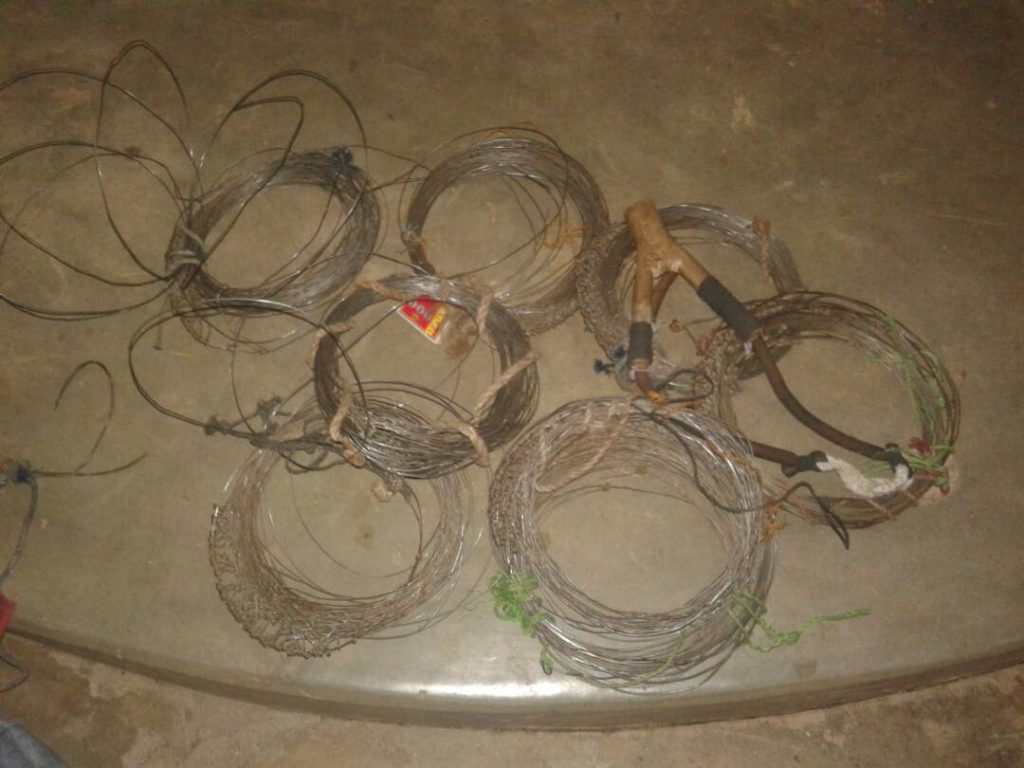
    Seized wire snares used for poaching wild animals like wild hare, spotted deer, wild pig, etc. for bushmeat (Photo Credit: A. Khune)

    Illegal wildlife hunting, more commonly referred to as poaching (the word ‘Poaching’ is derived from the Middle Eastern word “Pocche” meaning to put in a bag), is defined as “to take (game or fish) by illegal methods” by Merriam-Webster Dictionary. There is no legal definition for “Poaching” within the Act. There is no distinction between illegal hunting and poaching in India as per the law. Hunting and attempting to hunt any animal listed in Schedule I to IV is prohibited under the Act and is a punishable offence. Hence, poaching and hunting of wildlife can be used interchangeably.

    Compared to other countries, India has strong wildlife protection laws, but their enforcement varies depending on the region, protected area and the legal status of the natural habitat in question. Exceptions to the provisions of the Wildlife (Protection) Act, 1972, are:

    1. The law allows for hunting by the tribals from indigenous tribes of the Andaman & Nicobar Islands.
    1. Through “delegated legislation” hunting is permitted in Schedule 6 area (e.g Karbi Anglong, Assam) of the Indian Constitution for personal use only. Here, with regards to national legislation, hunting of all Scheduled species for commercial gain in India is illegal under the Wildlife (Protection) Act 1972. It is important to note that hunting of some species outside of Reserved Forests for personal use can be permitted for certain native tribal communities (notified by Autonomous Council) in Schedule 6 areas. In this context, if the Regional Council deems fit it can enact delegated legislation in the form of rules or regulations which either permit hunting by local tribes for personal use or can even restrict them completely. However, if the Regional Council has not made any such “delegated legislation” then “principal legislation” either made by the State or by the Central Government which restricts hunting outside Reserved Forests continues to be applicable. Furthermore, in case of conflict between delegated legislation of Regional Council and principal legislation, the latter will prevail since principal legislation is enacted by the State Assemblies in case of State law having the assent of the Governor and by Parliament in case of Centre Law having the assent of the President.
    1. “Fishing” is not equated with “hunting” under the Act except in the case of specific Scheduled species listed under Wildlife (Protection) Act, 1972.   

    In a broad context, illegal wildlife hunting/poaching and wildlife trade can be referred to as Wildlife Crimes (defined as any harm to (or intent to harm and subsequent trade of) non-domesticated wild animals, in contravention of the national and international laws and conventions).

    Wildlife hunting can be categorised based on five broad drivers, viz. (Harrison et al., 2015):

    1. Subsistence hunting for personal consumption as bush meat (sometimes as a result of taste and preferences), medicinal value and traditional values of wildlife derivatives,
    2. Hunting as a source of alternative livelihood opportunity which includes use of live animals for performance,
    3. Commercial hunting is mainly for economic gains arising from meeting foreign demand for wildlife derivatives i.e. illegal wildlife trade and trophy hunting and/or to cater to national rural and urban demand,
    4. Retaliatory/targeted hunting as a response to negative human-wildlife interface and,
    5. Opportunistic hunting is often defined as one-off hunting of wild animals as a result of proximity to wildlife habitat and species and/or during collection of firewood and non-timber forest produce.
    6. It is also a known fact that drivers and motivations for wildlife hunting stated above are not mutually exclusive. For example, species hunted as a result of targeted hunting could be consumed subsequently as bushmeat.

    India has a strong legislation, but the efficacy of the Wildlife (Protection) Act, 1972 is not limited to the provisions mentioned therein but, its enforcement and implementation on-ground and in this context, the words of Hugh Allen (1987) spell out the caveat most lucidly,

    “It is important to remember that strengthening the law alone is no substitute for enforcing what is already in the statutory book.”

    References:

    Allen, H. 1987. The Lonely Tiger. Penguin Books. London, UK. 

    Government of India., 1972. The Indian Wildlife (Protection) Act, 1972, Available at: http://envfor.nic.in/legis/wildlife/(Accessed October 22, 2016)

    Harrison, M., Roe, D., Baker, J., Mwedde, G., Travers, H. and Plumptre, A., 2015. Wildlife Crime: A review of the evidence on drivers and impacts in Uganda. IIED. London, UK.

    Corridor Conversations: an interview with Shivani Dogra

    An Interview with Shivani Dogra

    © PRASENJEET YADAV

    Welcome back to Corridor Conversations, and the next interview in our series on women working in connectivity conservation.

    Today, Harshad Sambamurthy speaks with Ms. Shivani Dogra, Conservator of Forests, Yadadri Circle, Telangana (IFS Batch 2007)

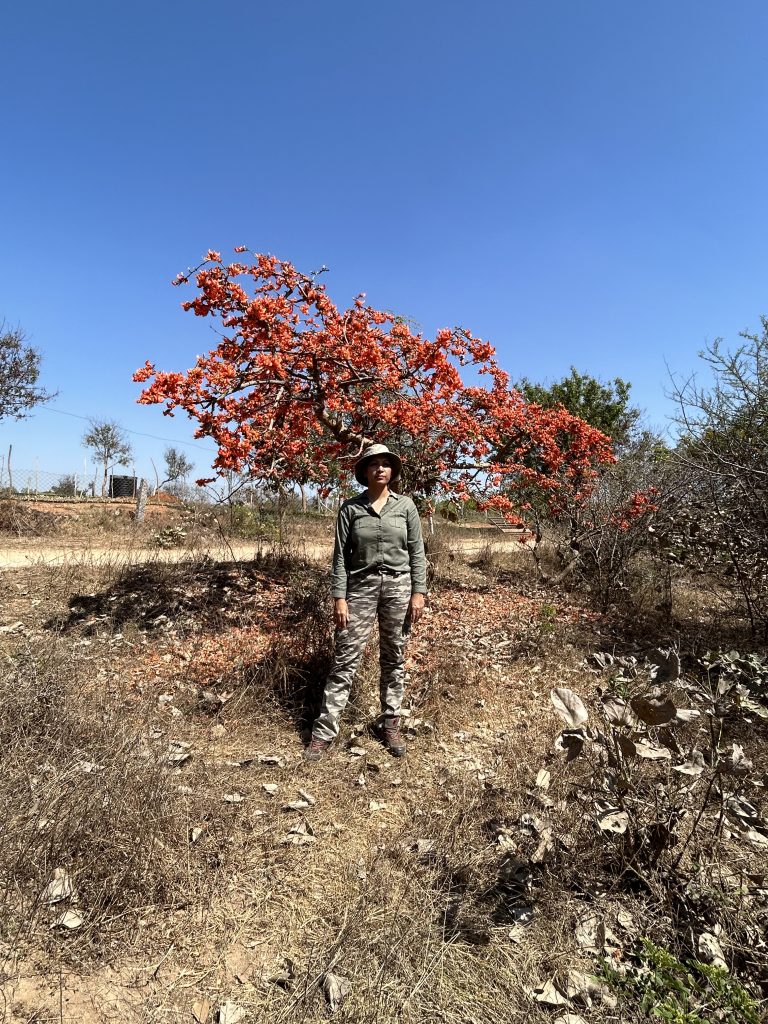
    Ms. Shivani Dogra, IFS Officer

    How has your journey in conservation been thus far? What drew you to this field?

    The journey has been great. I have had an opportunity to work in the forests of Andhra Pradesh and Telangana for the past 15 years; from the evergreen forests of coastal areas to places with the endemic Red Sanders. I have worked in various wildlife areas, and one of the most memorable experiences was in Kadapa; while working on the conservation of the critically endangered Jerdons courser. The journey continued to the Kawal Tiger Reserve, Telangana, and now, I am managing the dry deciduous forests in Yadadri.

    I come from the hills where you are always amidst nature. So, nature has always been a part of my life growing up. While I was studying forestry during graduation, we were taken around the country and were exposed to various forest and wildlife management activities in various states and that’s when simple studies turned into a lifelong passion. Have never looked back since then.

    Have you faced challenges as a woman working in conservation? What are some of the stereotypes you have had to fight against/ negotiate?

    Conservation demands restriction and that is the biggest challenge. Though everyone understands the importance of conservation, no one likes limitation. The choice between conservation and development has always been debated and remains so. Hence the challenge is immense. Being a woman in conservation has never been a problem for me. It has rather got its advantages. Once people understand your intent and determination, they come along and it becomes easier to walk on this path. Though being a working woman sometimes poses challenges as you are under constant scrutiny from the system, and under pressure to prove your capabilities time and again.

    What are some valuable lessons you’ve learnt that could benefit early-career women conservationists?

    I would say, “Just Go Girl”. Never let anyone or any situation break you as a woman. You are always expected to fulfil all your responsibilities; be it as a homemaker, as well as an officer/ entrepreneur etc. There will always be stereotypes. Just Stand your ground, be firm in what you believe. Remember one thing: You are STRONG, CAPABLE, and BETTER in every sense one can imagine. Just Don’t stop.

    In the landscape you work in, what are some of the similarities (or differences) you have observed in how forest-dwelling communities perceive wildlife, and the shared spaces they call home?

    The forest-dwelling communities that really depend on the forests worship them and know how to use these spaces without breaking the balance. And that’s the Mantra of conservation. However, with the changing socio-economic, socio-political scenario; just like everyone, their perception is also changing, and they have started looking at the forest as a commodity.

    At times, people do not want to acknowledge the importance of conservation and its importance to humanity. However, the efforts to protect and conserve nature as well as wildlife are showing results. Greening programmes have resulted in increases in green cover and has also led to awareness amongst the masses. One can see people actively participating in plantation drives and fighting for the cause of wildlife conservation. One can hope that the future for our younger generations is one that is green and clean.

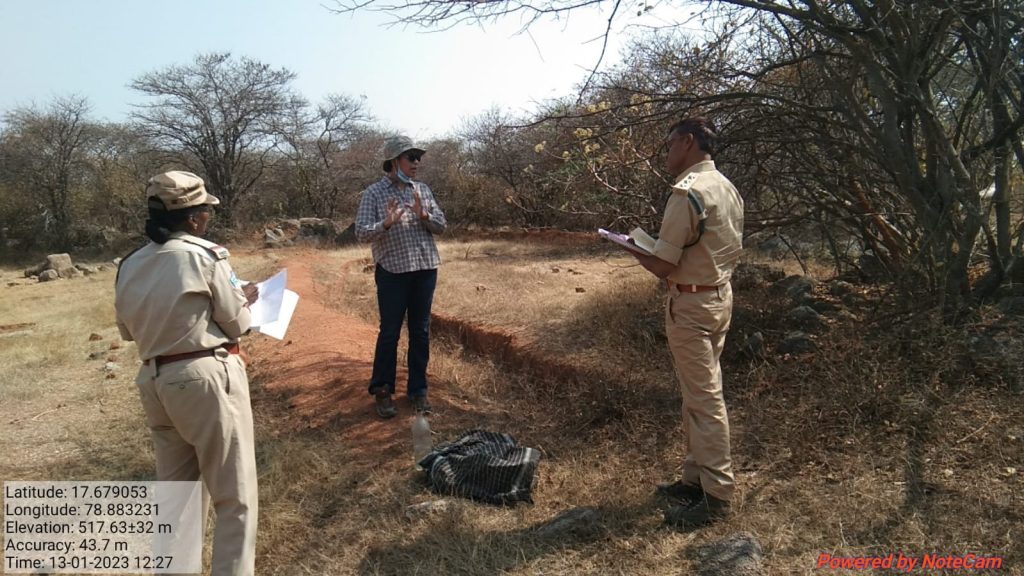
    On a field inspection with local officers in Yadadri

    In Telangana, are the local community supportive of the Forest Department’s interventions? As a Forest Department official, how have you navigated relationships with the local community?

    They are. However, the dependency of the people on forests, and their socio- economic status has a lot to do with their support to the forest department’s interventions. Many a time, their livelihood is a major consideration when we talk of conservation. Therefore, it’s a tough battle between conservation and development; as both are necessary for the people. Communication is key. However, certain times, people are not ready and thereby make it difficult to navigate this fragile relationship.

    Many a time, media coverage focuses on large mammals traversing fragmented habitat. How can we highlight the importance of connectivity for smaller species?

    That’s very true. We need to create awareness on the importance of smalIer species in an ecosystem, and their role in improving the habitat for developing and improving habitats for larger species. The exposure of media to all kinds of lives in a forest, at different trophic levels, and the efforts of conservation, connecting various landscapes is necessary for various species be it avifauna, amphibians, aquatic, mammals, or reptiles. This will definitely bring focus on such important and lesser-known species and their habitat connectivity.

    Linear infrastructure can often lead to instances of roadkill. Are there examples of mitigation measures from the areas you were posted in (or elsewhere) in Telangana that you feel have worked and feel to be effective, and think could be used in other landscapes?

    In most cases, underpasses have been used as major mitigation measures to prevent wildlife roadkill. Besides this, the speed limits while passing through wildlife areas/ Protected Areas have also been very useful. In addition to that, regulating the movement of heavy vehicles during the night has also been very effective (e.g. by erecting check posts at the entry and exit of such wildlife areas). In certain instances, even speed breakers are useful. There can never be a common strategy that will work for all areas as it will have to be tailored to the terrain, kind of forests, etc. Hence, strategies can be devised and implemented based on wildlife locations and traffic.

    What is the current status of tigers, and their connectivity in your landscape? What does the future hold?

    Even though urbanisation has increased, tigers are traversing old corridors again. This could be due to biotic pressures or increases in tiger populations due to conservation efforts, and their subsequent search for newer territories. The future calls for protecting such habitats and connecting fragmented habitats, or else conservation efforts will be in vain. Also, we will have to deal with more instances of human – animal conflict; therefore the coexistence we talk about today might not be relevant tomorrow. So, protection of these corridors needs to be our utmost priority.

    What are the foreseeable challenges in maintaining habitat connectivity? Realistically speaking, can they be maintained in the long-term, or is the arm of socio-economic development bound to cut through this longevity?

    Striking a balance between conservation and development has always been the greatest challenge. Most of the corridors fall outside the forests and include human habitations and other development areas, and as such, it is very difficult to exercise regulations on certain activities for maintaining such corridors.

    With corridors not recognised as a legal category, how does the Forest Department navigate that space? Is there internal clarity/ policy in place? What are some of the challenges here?

    Constantly trying to connect with people and explain to them how coexistence is the key to the existence of the humankind seems to be the only solution that I can think of right now, which is being followed by the Forest Department in wildlife corridors. There is no doubt on the policy or the guidelines, though it is a challenge to convince people to give preference to something that is not directly beneficial to them.

    How can we map tiger connectivity in a future that is likely to have more tigers, and surely to have more humans, and therefore more human-wildlife interactions? Is that a disaster waiting to happen or a global case-study in co-existence?

    It is all in our hands whether we want a disaster or coexistence. The definitions and understanding of development needs alteration. A culture that protects nature consciously is imperative. In India, I do not think it is difficult for our society, where we already worship all elements of nature. We worship possible plants and animals. A little push is all we need. I think coexistence is the only option we are left with.

    Corridor Conversations: an interview with Mahi Puri

    An Interview with Dr. Mahi Puri

    © PRASENJEET YADAV

    Welcome back to Corridor Conversations, and the next interview in our series on women working in connectivity conservation.

    Today, Harshad Sambamurthy speaks with Dr. Mahi Puri, Coexistence Scientist, Cincinnati Zoo and Botanical Gardens

    Dr. Mahi Puri

    How has your journey in conservation been thus far? What drew you to this field?

    Becoming a scientist or working in the field of conservation was never on my radar. Growing up, I was that annoying person who would go around switching off lights in the house or turning off the tap when someone was brushing. So, a conservation ethic was always there. Beyond that, I was unaware of any potential career paths in this field. A meaningless 6-month stint in the corporate world led me to explore options, and fortunately, I was soon hooked to wildlife conservation!

    The journey has been long. With no prior background, knowledge, or mentors in the field, I dabbled in wildlife filmmaking, rescue and rehabilitation, and finally research. I was on a constant quest to keep gaining more skills and learn about different pathways to bring about conservation success. My academic pursuits, including a Masters, and later a PhD, were always aligned to making a larger conservation impact.

    Of course, the journey has had its fair share of frustrations. Imposter syndrome, gender bias, cynicism and financial insecurity have remained a constant through a significant part of the last 15 years. But it has also been a journey of self-exploration that has been extremely fun and rewarding. Over the years, I have had the opportunity to work across spectacular landscapes of India; from the alpine mountains of Kashmir to the grasslands and rainforests of North-East India, from the deciduous forests of Central India to the rich and diverse ecosystems of the Western Ghats. For a brief period when I studied inter-tidal gastropods, I hopped across beaches along nearly 1200 kms of the Western coastline! All these experiences exposed me to how extraordinary India was, not just in its wildlife and wild spaces, but also across cultures. Along the way, my passion for wildlife intersected with a more nuanced understanding of the myriad ways in which people navigate living with wildlife and their perceptions about conservation, livelihood security and governance issues. I have also had some incredible mentors and colleagues who’ve taught me an extraordinary amount about wildlife conservation, hand-held me through the highs and lows of academia and to pursue my passions without compromising on work-life balance. The evolution in the quality and type of work I have pursued is a consequence of all the above and is linked to my personal growth in the field.

    Have you faced challenges as a woman working in conservation? What are some of the stereotypes you have had to fight against/ negotiate?

    Yes and no. Today I see a lot more women working in conservation, but that was not the case a decade ago in India. For most of my field expeditions, I was the only woman in a team of 4 – 10 men. While I remained safe from issues of sexual harassment at work, I’ve always had to prove my abilities to do even the most basic tasks; be it my ability to drive on dirt roads, to be able to walk in tough terrain or areas with abundant elephants or large carnivores, and to be able to lead teams. Once, a supervisor asked why I was in a forest, and not in a beauty salon! Someone else said that I looked like an adivasi because I had tanned after 3 months in the field. I’ve navigated similar questions from colleagues, forest department officers, and family members. That women should stick to social science and avoid ecological research was a common thread. Again, while these biases should not be a part of any female scientists’ experiences, in my own projects I have tried to do the opposite by including an equal number of women volunteers/interns, ensuring their safety in field camps, and creating opportunities to learn both ecological and social skills in interdisciplinary projects, irrespective of gender.

    What are some valuable lessons you’ve learnt that could benefit early-career women conservationists?

    Speaking from a position of privilege, while my family did worry about my personal and financial security in my early years, they stood by me and supported me. I recognise that that may not be the case for many early-career women conservationists. I think that one of the big factors that built my family’s trust in my choices was the courage, determination and empathy I demonstrated. At some instances I may have even been labelled as stubborn! But my personal experience has taught me to keep striving for excellence, keep taking small steps towards larger goals, and to ignore the noise that questions your abilities. Also, take it slow. There’s no rush to fall to societal norms of when to get married and when/whether to have children. If along the way you feel you’re stuck, reach out. You’ll always find some guidance – intellectually, emotionally, and spiritually.

    In some of the landscapes you have worked in, what are some of the similarities (or differences) you have observed in how forest-dwelling communities perceive wildlife, and the shared spaces they call home?

    This has been so interesting to observe. Within the academic/professional conservation circles, we all boast about the tolerance for, and acceptance of, wildlife among communities in India. There is an incredible amount of respect that I have witnessed for wildlife and wild spaces, be it among the Toda communities in the Nilgiris or the Gond and Baiga in Central India, or the Gujjars and Bakarwals of Jammu and Kashmir. Wildlife are seen as sentient beings with their own powers, agency and needs. There is also immense knowledge about the ecological role of different species. Once, an elderly woman went into a state of trance when we showed her a picture of a tiger for a survey. Another time, a farmer in Madhya Pradesh collected the soil from a tigers pugmark on his farm to worship because tigers kept the deer away and thus protected his crop. Having said that, different species of wildlife present a multitude of stresses to people’s daily lives and livelihoods. These challenge people’s inherent value orientations. People’s value systems are also constantly being challenged and shaped by governance institutions and the associated power dynamics. As a conservation scientist, its very important to tease apart all these complexities to prevent values from eroding while ensuring sustainable livelihoods.  

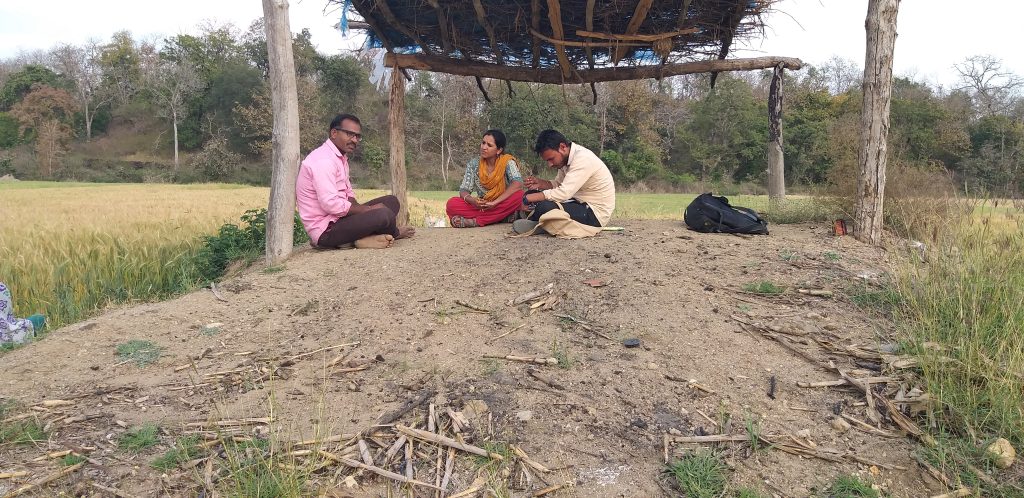
    Conducting stakeholder interviews

    In a paper of yours, you illustrated how the usage of media reports has helped examine leopard distribution, cases of depredation, and suggested management practices outside PAs. While media coverage can often be a good source of information for larger mammals, how can we highlight the importance of connectivity for smaller species?

    This project took place while I worked at WCS-India/Center for Wildlife Studies in 2014. The organisation’s media and communication team collated daily news about wildlife from across India, and more intensely, from within Karnataka (by including regional media as well) and shared this with the employees. What an incredible asset! For us scientists (and nerds), this was data! Yes, species like leopards, tigers, elephants, bears etc. catch the media’s attention and do get reported more frequently because of their charisma, elusiveness and the nature of their interaction with people (whether positive or negative). However, I think media reporting is also linked with the kind and amount of research that’s happening on the ground. If there is good research ongoing or available, and scientists to reach out to, then it may be easier to have popular articles on different species. Conservation attention can be garnered for several smaller species by conducting long-term ecological studies on them. For example, no one talked about fishing cats a few years ago. But rigorous and long-term projects on the species’ ecology have brought attention to their needs, threats, and their overlooked wetland habitats. If similar quality of work is conducted on other species, then we can bring media attention to them as well. To start with, there is a tremendous amount of by-catch data already available from camera-trap studies that were targeted at large mammals (especially tigers). Establishing baselines from these datasets can be the starting point for more long-term work, whether it’s on species diets, behaviour, habitat use, population dynamics or interactions with people.

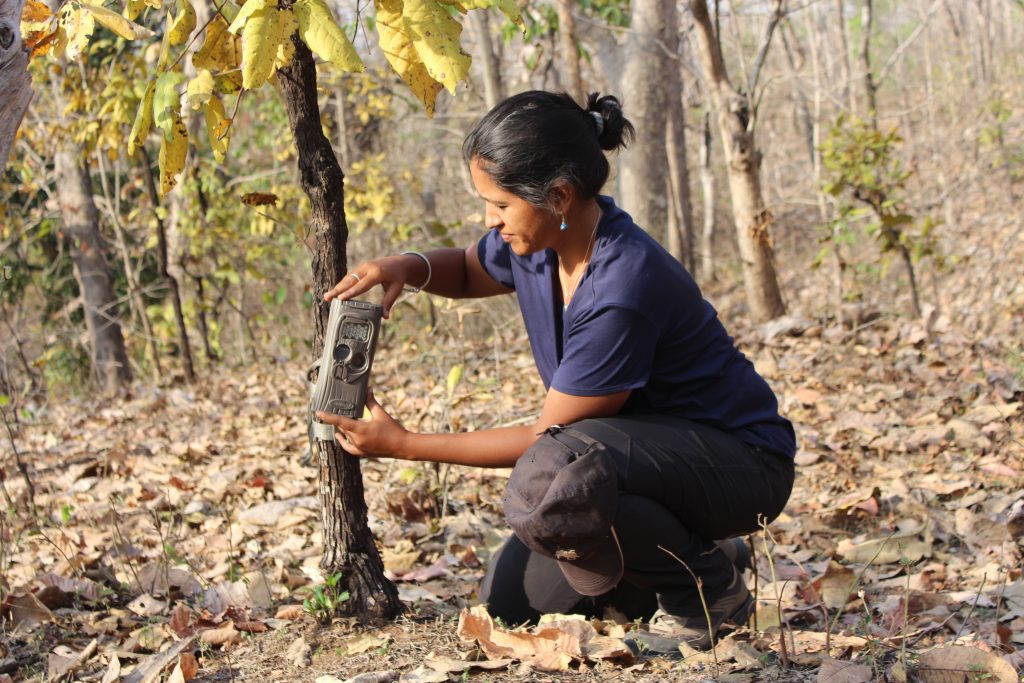
    Setting-up a camera-trap

    What are the foreseeable challenges in maintaining habitat connectivity? Realistically speaking, can they be maintained in the long-term, or is the arm of socio-economic development bound to cut through this longevity?

    Infrastructure development and land-use change are some of the biggest challenges. These threats are not going to get eliminated any time soon. To maintain connectivity, conservationists are faced with two approaches, which can sometimes be ideological conflicts. One, develop neo-liberal solutions that integrate market-based solutions and work around/with these capitalist challenges. Two, a radical conservation approach where forests are set aside and conservation is in the hands of communities. Personally, my research has been an attempt to bridge these approaches and find a pathway through which communities can be empowered (through financial and non-financial incentives, and capacity building) to conserve wildlife and shared lands. 

    Can eco-tourism play a role in strengthening community livelihoods along corridors? Might it also serve to drive home the economic benefit of their conservation at the policy level?

    The four key principles of ecotourism include environmental protection/ wildlife and nature conservation, community participation, socio-economic development, and education and awareness. In its current form, the type of tourism that’s being practiced around most nature reserves in India is not ecotourism (there are some exceptions). It is still largely an exclusionary industry with limited assimilation of any of the principles. However, I think ecotourism as a concept has tremendous potential both from the perspective of connectivity conservation as well as community engagement and socio-economic-political empowerment in conservation decision-making.

    Several corridors in India are mosaics of fragmented forests and agriculture. From your work in these multi-use spaces, do you get a sense that the importance of these mosaics for connectivity is recognised by the stakeholders? 

    I can only speak from my experience in Central India where I have worked in corridors. While local communities recognise and acknowledge the importance of forests and wildlife, I think the understanding of the larger role of corridors or the part that people play in maintaining connectivity is missing. Yes, there has been a lot of awareness campaigns and outreach carried out by different NGOs working in the landscape. But to a large extent, they’ve been limited to only imparting knowledge. Beyond that, the term “corridor” often has a negative connotation and is associated with another tier of protection that may bring about relocation, or increase wildlife numbers, and therefore conflict. Through my conversations and work with farmers, I have learnt that clarifying that link and emphasising people’s crucial role in connectivity conservation can be very encouraging as it has the capacity to enhance people’s self-efficacy, or the perception that they have the ability to make a difference to conservation as well as to their welfare.

    How can we map wildlife connectivity in a future that is likely to have more humans, and therefore more human-wildlife interactions? Is that a disaster waiting to happen or a global case-study in co-existence?

    The cynic in me always asks this question. But to continue working in this field requires keeping hope. As a conservation scientist, we have to keep finding ways to innovate and find solutions so that coexistence can be fostered, maintained or enhanced, whatever the case may be. But it’s also important to remember that coexistence does not mean a complete absence of conflict. With conservation success, losses to both people and wildlife are inevitable. The challenge is to identify what are the tolerable levels of losses, and to revise those thresholds with changes in the local dynamics. 

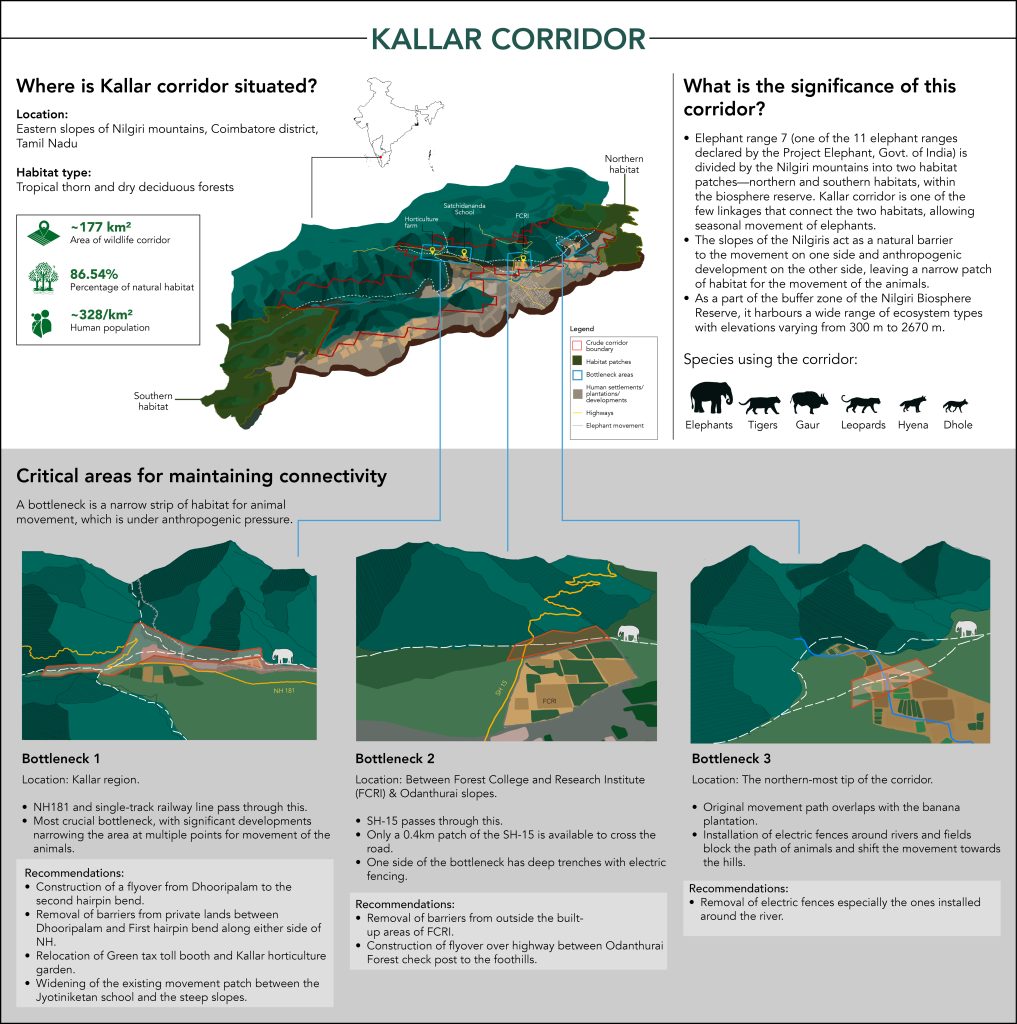
    The Kallar Corridor

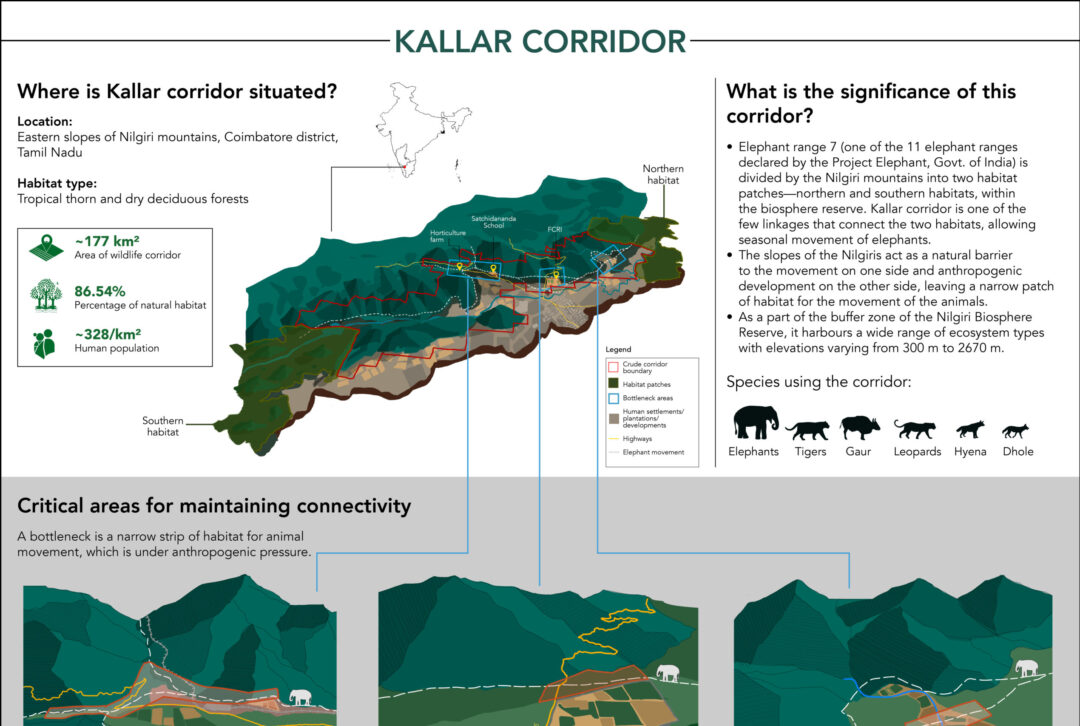
    The Kallar Corridor – An Infographic

    © PRASENJEET YADAV

    Illustration: Rucha Bhave & Text: Rutuja Bhatade

    Located on the eastern slopes and foothills of the Nilgiri mountains, the Kallar corridor connects two parts of the largest elephant range in India. The slopes of the Nilgiris act as a natural barrier to elephant movement on one side of the corridor and anthropogenic development on the other side. It leaves a narrow patch of habitat for the movement of the animals. Apart from elephants, this corridor is used by several other mammals, including the tiger, leopard, sloth bear and striped hyena. Electric fences around farms and institutions that overlap with the corridor, as well as increased traffic on national highway NH-181 passing through the corridor, impede animal movement and are a significant concern.

    Corridor Conversations: an interview with Jodi Hilty

    An Interview with Dr. Jodi Hilty

    © PRASENJEET YADAV

    Welcome back to Corridor Conversations, and the next interview in our series on women working in connectivity conservation.

    Today, Harshad Sambamurthy speaks with Dr. Jodi Hilty, President and Chief Scientist of the Yellowstone to Yukon Conservation (Y2Y) Initiative.

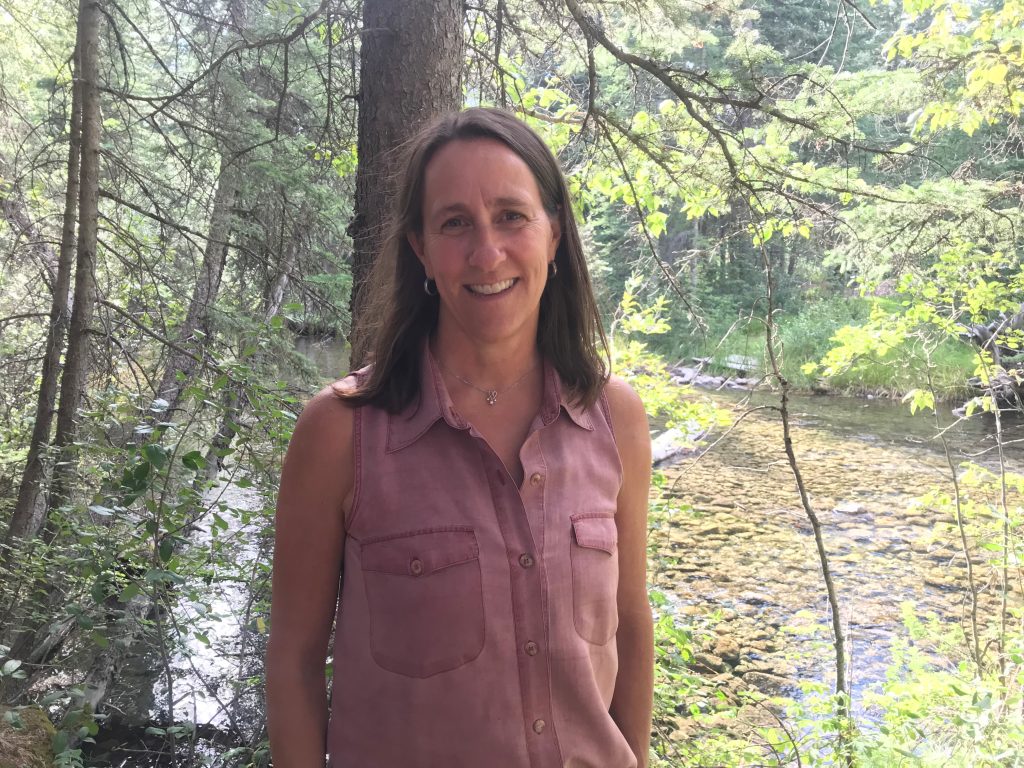
    Dr. Jodi Hilty (Credit: Y2Y)

    How has your journey in conservation been thus far? What drew you to this field?

    For me, it has been incredibly rewarding to work in this field. When I started studying ecological corridors in 1996, some leaders in conservation biology questioned whether corridors were really necessary. Today, connectivity is prominent in four different places in the global biodiversity framework created in December 2022 at COP15. So exciting to be part of that shift! Also, it is promising to see conservation advancing globally as well as across the Yellowstone to Yukon (Y2Y) region, where protected areas increased by more than 80% and where there were zero structures to help wildlife get over and under roads safely in 1993 to now 117 such structures across the region. We have so much more conservation to do, but such progress is incredibly heartening.

    Have you faced challenges as a woman working in conservation? What are some of the stereotypes you have had to fight against/ negotiate?

    Certainly, I have faced challenges as a woman, especially in the first couple of decades in my career when I was frequently one of the only, if not the only, woman in the room. I feel lucky that most of the people I worked closely with supported me. In one case, a person with seniority told me to watch that I wasn’t too ‘aggressive’, which I could only privately laugh at given that this person often raised their voice aggressively and acted unprofessionally. In another case, someone told me that my salary should not be the same level as the person previously in a position I was taking, both because it was too big of a salary leap and because I was ‘too young’ and I shouldn’t move up too fast. That too was ironic because a new CEO arrived at that organisation who was almost my age, clearly making significantly more money.

    What are some valuable lessons you’ve learnt that could benefit early-career women conservationists?

    Three recommendations:

    1. Learn to negotiate – I have now hired many early-career professionals. My observation is that males were much more inclined to negotiate for what they wanted during and after hiring; be it salary, office spaces, special opportunities, or other priorities. Everyone can benefit from practice and learning how to engage in professional negotiations for themselves and their staff much earlier in their career.
    2. Be comfortable being seen – Where other big personalities dominate rooms, I have witnessed early-career women who try to blend into the background. However, remember that we all have something to contribute and making space for your ideas as well as ideas of others is important.
    3. Work with people who support you and you support – The number one contributor to job satisfaction is whether one enjoys working for their supervisor, followed by whether one feels they have a good team. This requires nurturing, attention, and caring about relationships. Occasionally it may require leaving a seemingly good job for another job if the environment can’t be a positive space.

    In the landscapes you have worked in, what are some of the similarities (or differences) you have observed in how communities perceive wildlife, and the shared spaces they call home?

    I have had the good fortune in living and working in a variety of places around the world. In highly urbanised areas like New York City, I found that, generally, people appreciate green spaces and the idea of wildlife, but many would be averse to hunting. This is in contrast to rural communities in Montana, where hunting for food is normalised and very much a part of the culture; and therefore a different way of relating with nature. In recreation-focused communities like Canmore in Canada, nature is often viewed more as a place to hike, ski and more. In many rural communities of Zambia, and among Indigenous communities in the Yellowstone to Yukon region, humans and culture are often viewed as being strongly interlinked with nature; where humans are part of nature. That is to say, that perceptions of nature may be highly dependent on where one grows up and the communities within which one is raised.

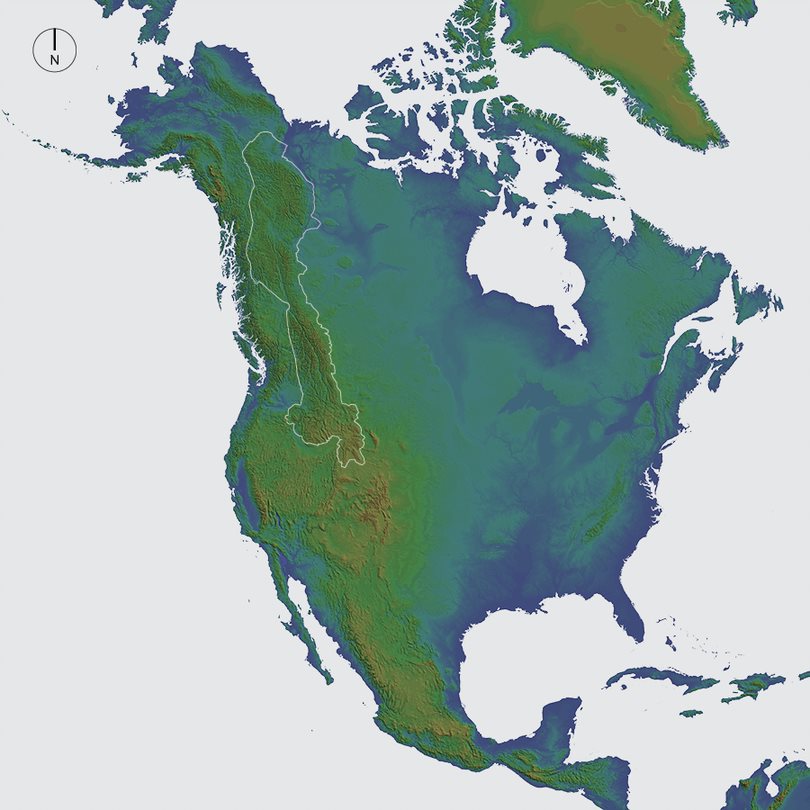
    The Yellowstone-Yukon region (Credit: Y2Y)

    Many a time, media coverage focuses on large mammals traversing fragmented habitat. How can we highlight the importance of connectivity for smaller species?

    Bigger, charismatic animals can often help to tell a story. Once a community or key audience begins to understand the importance of connectivity for wildlife, it may be time to talk about the connectivity for smaller species be it frogs, mycorrhizal fungi in the ground that connect trees, or other species. Storytelling is a much more powerful tool than science facts. Those of us in the science community would do well to practice our storytelling and pair up with communications experts to help us tell our stories in ways that best resonate with key audiences and ultimately obtain needed support for key conservation actions.

    Linear infrastructure can often lead to instances of roadkill. What are some of the mitigation measures you have used/ studied/ seen in the field and feel to be effective, and think could be used in other landscapes?

    At this time, the most effective tools we have for addressing linear infrastructure, such as roads or rail lines, is using under- and overpasses for wildlife to move across them. These structures generally need associated fencing to direct wildlife off of roads and to the structures themselves.

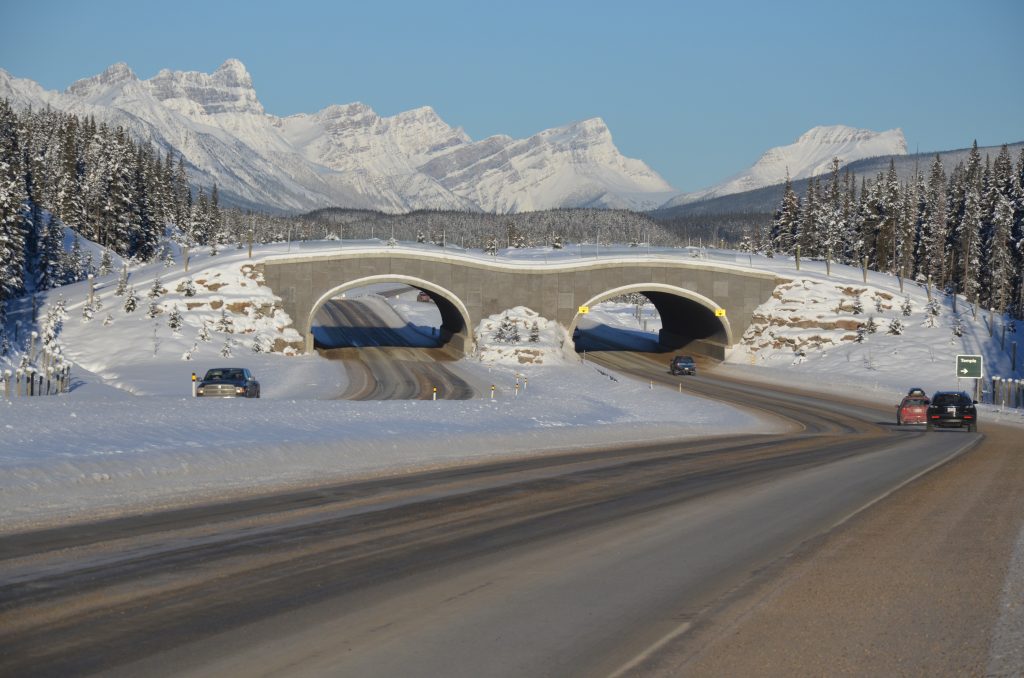
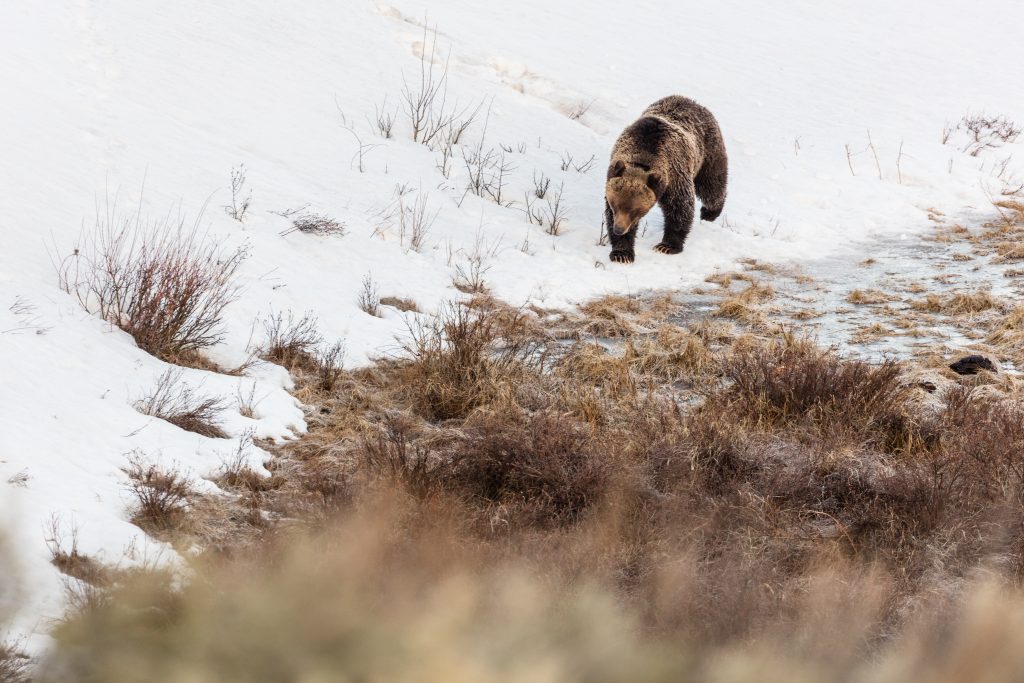
    One of the world’s most studied crossing systems is in Banff National Park in Canada which has 38 underpasses and 6 overpasses across an 82-kilometre section of the Trans-Canada Highway, which divides the park. We know from the cumulative research that it took time for wildlife to find, and increasingly use these structures. They are also highly effective, eliminating 96% of collisions with hooved animals. Research also shows that males and females of the same species may have different needs. Female grizzly bears with cubs, for instance, use overpasses, whereas males will use under- or overpasses, so overpasses are vital for demographic connectivity in the long term.

    We are already seeing these structures used around the world: from India with elephants and tigers, and in China, where the Chinese buried a road to re-create landscape connectivity for pandas. Europe, Australia and South America are also advancing various types of over- and underpasses for their wildlife. It is truly awesome to see these proliferate around the world. Perhaps success is when such structures are normalised and thus required for any busy highway.

    One of the six overpasses in Banff (Credit: H. Locke)

    What are the foreseeable challenges in maintaining habitat connectivity in countries in South and South-East Asia? Realistically speaking, can they be maintained in the long-term, or is the arm of socio-economic development bound to cut through this longevity?

    I am no expert in Asia conservation, so I will just offer some high-level thoughts. The Belt and Road Initiative and other insidious and continual road building especially across largely intact swathes of nature not just in Asia but throughout the world are huge challenges because each country must decide where those roads will go and how much to allocate to mitigating these linear developments for nature. Like any infrastructure, wildlife under- and overpasses and associated fencing does require ongoing maintenance, and over the longer-term, even replacement. Whether such maintenance is achieved will depend on the values of those in charge because there is always competition for scarce dollars. Countries like Bhutan and Costa Rica have prioritised connectivity conservation and protected areas because their economies are dependent on nature. For such structures to be installed—not to mention maintained—requires that the society where these will be installed values nature and understands the importance of connectivity. This means citizens will support and even demand that their government will continue to prioritise them not just in the short-term but over time.

    What were some of the challenges you faced when helping establish the Yellowstone – Yukon initiative? What role do the various local and indigenous communities play, both for establishment and maintenance of this massive landscape?

    In 1993, when the idea of the Yellowstone to Yukon (Y2Y) vision was created—of connecting and protecting an area from south of Yellowstone National Park in Wyoming to the Arctic circle in the Yukon for people and nature to thrive—many were attracted by the ambitious and audacious idea, but others felt it was absurd. A popular TV show in the early 2000s, The West Wing, presented it as a ‘crackpot’ idea. Others wondered whether such a big vision would make a difference since conservation action has to happen at a much more localized scale. Now that we are 30 years into realizing that vision, we have been able to prove that the vision is something that so many people and groups have rallied around, and the result is concrete and tangible conservation such as new protected area creation happening in the Y2Y region at double the rate of protected area creation across North America.

    The Y2Y region criss-crosses at least 75 Indigenous Territories, and Y2Y recognises the importance and value of Indigenous knowledge acquired by Indigenous Peoples over the course of their long relationship with the landscape and seek to respect and uphold Indigenous rights. Today, about a quarter of protected areas are managed or co-managed by Indigenous Peoples. In the Canadian portion of Y2Y, about 14 million acres of new protected areas have already been agreed upon in the last few years by Indigenous, regional and federal governments, all of which will be designated on-the-ground soon. Many other Indigenous governments are advancing visions of new Indigenous-led protected and conserved areas, and Canada is committed to advancing new Indigenous protected and conserved areas. In the United States, Indigenous People are also increasingly putting forward ambitious conservation visions such as the Nez Perce vision of a Camas to Condors climate change corridor initiative or the transboundary Blackfoot Confederacy Iinnii Initiative, which is focused on conservation of traditional lands, Blackfeet culture, and restoration of buffalo. That is to say, that Indigenous Peoples are critical in both the establishment of, and long-term care, for protected areas across the Y2Y region, and it is a way for them to realise their rights across their territories.

    A Grizzly Bear in Yellowstone National Park (Credit: Y2Y)

    How can we map large mammal connectivity in a future that is surely to have more humans, and therefore more human-wildlife interactions? Is that a disaster waiting to happen or a global case-study in co-existence?

    I wish that I had the crystal ball to anticipate the future. Given that such a crystal ball doesn’t exist, it is important that we understand and prioritise connectivity conservation between protected areas. We know that isolated protected areas generally cannot maintain all the species and processes required to sustain a healthy, functioning system and that connectivity can help, and that climate change means that many species will need to move across time and space make connectivity all the more essential. Lots of global connectivity mapping has been and continues to be done, from Saura et al.’s efforts to model the level of protected area connectivity globally or Kauffman et al.’s ongoing effort to map ungulate migrations.

    Such mapping helps us understanding where the critical places are, but must be followed by a second step: ensuring that these places are conserved for connectivity over the long-term. The IUCN Guidelines on Ecological Network and Connectivity provides strong guidance on how to get to enduring connectivity conservation. Many countries and regions around the world have already developed formal programs (e.g. Australia, Canada, Costa Rica, Europe’s Natura 2000, Kenya, Tanzania, etc.), and the new globally agreed upon Biodiversity Framework prioritises connectivity, which is both a mandate for the world and a recognition by global society of its importance. Our job then is to get it done in the Y2Y region, in India and around the world so that we are able to conserve nature at the scale that it needs to be conserved!

    Corridor Conversations: an interview with Uma Ramakrishnan

    An Interview with Dr. Uma Ramakrishnan

    © PRASENJEET YADAV

    We are excited to launch Corridor Conversations; an interview series with women working in connectivity conservation.

    To kick things off on International Women’s Day 2023, Harshad Sambamurthy speaks with Dr. Uma Ramakrishnan, molecular ecologist and Professor at the National Centre for Biological Sciences (NCBS), Bengaluru, on her journey and work.

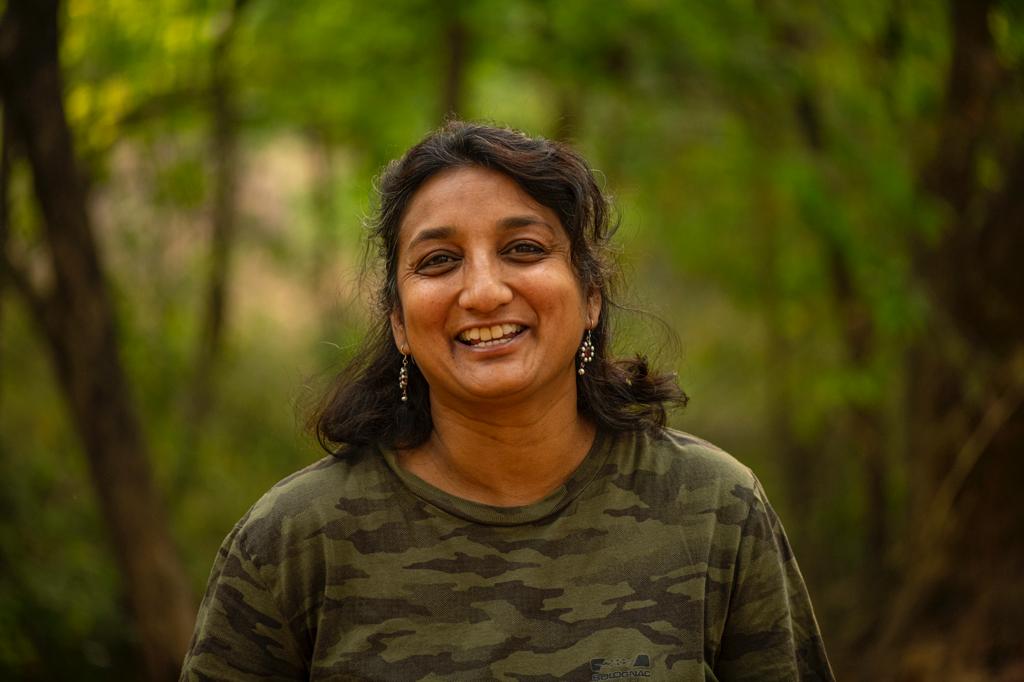
    Dr. Uma Ramakrishnan (Credit: Prasenjeet Yadav)

    How has your journey in conservation been thus far? What drew you to this field?

    I have been lucky to have had the amazing opportunity to see India through the lens of wildlife while investigating conservation science. Through the last eighteen years of my career in India, I have worked with my laboratory colleagues on birds, lizard, and mammals. We have worked in most habitats and states (with the exception of Tripura, Jharkhand and Bihar).

    Conservation science itself is a difficult field, the state of the environment can be depressing. It’s like this secret you are privy to that will negatively effects lots of people and is really sad. Yet no one seems to take it seriously! You feel like shaking people and asking them: “don’t you realise that extinction rates are very high right now? That biodiversity loss is real? That soon, the impacts of our changing climate will be devastating? That zoonoses will become more and more common, as the interfaces between humans and wildlife increases?” Many times, the results you find do not get translated into action on the ground, not because it is not good science, but because there are other considerations. But you just have to keep going. Pursuing a career in conservation science requires determination! But not everything is negative! I think we have witnessed recovery of tigers, for example, over the last decade. That’s really cool and something to be happy about!

    I always loved animals, wildlife and wild spaces! Growing up, our family moved a fair bit, and my father loved to travel. I would insist on going to zoos wherever I visited! I was lucky to grow up in the Indian Institute of Science campus where I was exposed to researchers studying ecology at the Centre for Ecological Sciences through high school and college. I visited the Western ghats many times, and somehow, just loved wildlife. Conservation naturally came after.

    Have you faced challenges as a woman working in conservation? What are some of the stereotypes you have had to fight against/ negotiate?

    Hmm… difficult question to answer. I think the hardest part of this work is the permissions process. Not because you do not get them; I am lucky to have permits in many places and like I said, have worked in many locations, but the process just takes long and is uncertain. These spaces, that of bureaucracy, is very male dominated. I guess I have just internalised it, but recently my teenage daughter came with me for such a meeting, with forest officers, and she commented on how male dominated these spaces are. I realised this afresh. It is not that I have faced any significant challenges because if this, but just something to realise. This makes for a dynamic of a certain kind. Stereotypes, well, because I am relatively informal and laid back, many people think I am not very serious. This is not true at all! In fact, quite the contrary, I am very serious and committed to my work.

    What are some valuable lessons you’ve learnt that could benefit early-career women conservationists?

    Never think you are less. Even if you think your family or personal responsibilities will slow you down, don’t worry about it, everyone has them. Believe, deep down, that you are unique. And bring your unique energy, perspective and brilliance to whatever you do. Understand your strengths, and don’t hesitate to bring them to the forefront of what you do. Put simply, believe in yourself!

    Dr. Ramakrishnan with her students at NCBS in 2014

    Many a time, media coverage focuses on large mammals traversing fragmented habitat. How can we highlight the importance of connectivity for smaller species?

    A very important question. I think some of the research we are doing on multi-species connectivity might be a great way to  highlight connectivity needs for varied types of species.

    Also, we can try to focus on habitats, restoration and other such activities outside protected areas that will effectively result in both human benefits through ecosystem services, as well as connectivity for smaller species.

    Linear infrastructure can often lead to instances of roadkill. What are some of the mitigation measures you have used/ studied/ seen in the field and feel to be effective, and think could be used in other landscapes?

    In my experience, underpasses for wildlife are effective. In addition, it might be interesting to try traffic regulation (hours and types of vehicles) as well as push-pull strategies that repel/draw wildlife towards specific paths/areas. This is an area that needs more research in India, as evidence-based strategies are critical to plan and successfully implement mitigation.

    What are the foreseeable challenges in maintaining habitat connectivity? Realistically speaking, can they be maintained in the long-term, or is the arm of socio-economic development bound to cut through this longevity?

    I am a bit of a pessimist in this regard. I think that at least for species like tigers and elephants, it will be increasingly difficult to maintain connectivity naturally. I feel that 50 or so years from now, we might have to move to a model of managing connectivity through animal introduction. But maybe I will be proven wrong!

    We now understand that tigers in Ranthambhore are genetically isolated. Without connectivity to Kuno, for example, these tigers might lack the genetic diversity for longevity. How can we further this link, between corridor maintenance and genetic diversity at a policy level?

    Difficult question! From a science perspective, we have shown that tigers here are inbred. I would like to be able to better understand the impacts of such inbreeding in the future. When might we see inbreeding depression (decreased individual fitness which will eventually result in lower growth rate), and how will this inbreeding depression look like? What level of gene flow from another gene pool would offset it? These are all important questions. In terms of policy, they relate to the questions above. If we are eventually unable to maintain connectivity, all populations will become isolated like in Ranthambore. How will we then devise genetic rescue strategies? I hope that in the future, such management and policy can be developed based conceptually on population genetics and demography, built on genomic data and our understanding of phenotypic effects of genetic variation. It is my dream to contribute scientifically to such a policy!

    Uma in the field with her team

    How can we map tiger connectivity in a future that is likely to have more tigers, and surely to have more humans, and therefore more human-wildlife interactions? Is that a disaster waiting to happen or a global case-study in co-existence?

    Very, very, difficult question. I think about it sometimes in the middle of the night, especially because in my lab, we have studied both: connectivity and conflict. I can only say that integrative approaches, such as those highlighted in Vasudev et al. 2022, would be a critical first step. I look forward to rigorous testing of the models and approaches they propose so that we can move towards addressing both sides of the same coin.

    Crossing the Road Safely: How Tunnels and Fences can Reduce Herpetofauna Mortality

    Crossing the Road Safely: How Tunnels and Fences can Reduce Herpetofauna Mortality

    © PRASENJEET YADAV

    Yashi Dwivedi

    A country’s social and economic progress is aided by rapidly expanding road networks, but animals often pay a heavy price for such development. Roads passing through natural habitats hinder animal movement and increase the risk of animals being hit by vehicles while trying to cross.

    While road accidents involving larger species like the tiger and elephant often get reported, there is little information available on the impact of roads on smaller animals like birds, reptiles, and amphibians that are equally rare, endangered, or threatened. These species are vulnerable to road effects because of their smaller size, relatively slower speed, and limited road avoidance behaviour, as the asphalt provides warmth on cooler evenings. This is of concern as reptiles and amphibians are among the most rapidly declining taxa globally.

    Given their vulnerability, ensuring presence of proper mitigation measures is critical. Mitigation measures are often a combination of barriers (such as fences) that prevent species from crossing roads and lower the risk of mortality, and crossing structures (such as tunnels and underpasses) that provide safe passage for smaller wildlife; facilitating movement and improving wildlife connectivity. However, just incorporating such mitigation methods does not always ensure alleviation of the negative impacts of roads. In order to ensure and improve the success of mitigation measures, examining their use and effectiveness by the target species is vital.

    In a recent study, scientists from Laurentian University in Ontario, Canada, investigated the impact of mitigation measures on amphibian and reptile populations in Presqu’ile Provincial Park (PPP), Ontario, Canada. PPP is home to five species of turtles and snakes, three species of salamanders, and nine species of frogs. A road runs right through this park. Although the park did not have any mitigation measures in place when established, a combination of fencing (to prevent crossings), and a couple of tunnels to facilitate crossing were put in place a few years ago. The authors wanted to understand whether mitigation promotes connectivity while lowering mortality. For that, they gathered data on roadkill and successful road crossings before, during, and after the mitigation structures were built. Data was collected using camera-traps placed on either side of the tunnels to capture the species using them. Along with cameras, the authors also tagged a subset of the species using PIT tags and installed scanners to detect the tags at one end of the tunnels.  Additionally, surveys were done three times a day on bicycles to detect road kills and crossings along the road between  2013 and 2018. Surveyors walked the road after conducting bicycle surveys so as to maximise detections.

    A Midland Painted Turtle in Presqu’ile Provincial Park (Image Credit: K. Osborne)

    The authors found that mitigation measures significantly reduced the number of turtles and amphibians on the road. However, they did not have an impact on the number of snakes found on the roads, likely because the snakes were thin enough to  traverse through the fence. Tunnel usage by all studied species was high. Cameras recorded 72 snakes, 615 frogs, 217 salamanders, and 54 turtles using tunnels. In order to understand if the number of crossings observed was enough to maintain connectivity and prevent negative impact of the road on species populations, the authors estimated the population size of a couple of study species—the painted and snapping turtles—in the study area. They found that 5% of painted turtles and 12% of snapping turtles used the tunnels for crossing the road during the study period. Based on other studies, authors suggest this is likely to be enough to prevent road impacts. However, they acknowledge that further investigation is needed.

    Mitigation measures that ensure roads do not fragment wildlife habitats are gaining global popularity and are increasingly being incorporated into infrastructure projects within India. However, most of the current mitigation measures are focused on large mammals. Structures like box and pipe culverts, routinely built for passage of water and small streams under roads or railways are often used by amphibians and reptiles. Incorporating considerations around ecology and biology of smaller species while planning placement and design of these culverts, could be a first step towards conservation of often-ignored species. Amphibians and reptiles are essential to the health of the environment and are valuable for natural biological pest control since they are significant predators of numerous insects and agricultural pests. It is important we don’t ignore the little stuff when it comes to linear infrastructure and road-impact mitigation.

    Thumbnail Image Credit: A Snapping Turtle in Ontario, Toronto Star