Wildlife Corridors and India’s National Wildlife Action Plan:
Current Status and Key Highlights
© PRASENJEET YADAV
Vidushi Pant and Somreet Bhattacharya
In the pursuit of conserving its diverse and endangered wildlife, India has been formulating long-term National Wildlife Action Plans (NWAPs) since 1983. These have emerged as critical advisory plans to guide different departments and committees in strengthening their efforts to protect India’s wildlife. In this article, we explore the current status and key highlights regarding corridors within the framework of the latest plan. This article is the second segment in our series exploring the integration of wildlife corridors into the NWAP. For a concise overview of how NWAPs have evolved to incorporate wildlife corridors, please refer to our initial article, available here.
The third version of the National Wildlife Action Plan (NWAP), covering the period from 2017 to 2031, builds upon the experience of the preceding two plans and the concurrent advancements in our understanding of landscape ecology over the decades. Unlike the first two versions, it adopts a landscape-level approach to conservation and suggests several actions and projects for strengthening and promoting the integrated management of wildlife and their habitats, including wildlife corridors. It calls for strategies for delineating landscapes, managing wildlife corridors, and involving stakeholders to maintain ecological connectivity.
Delineation of Landscapes
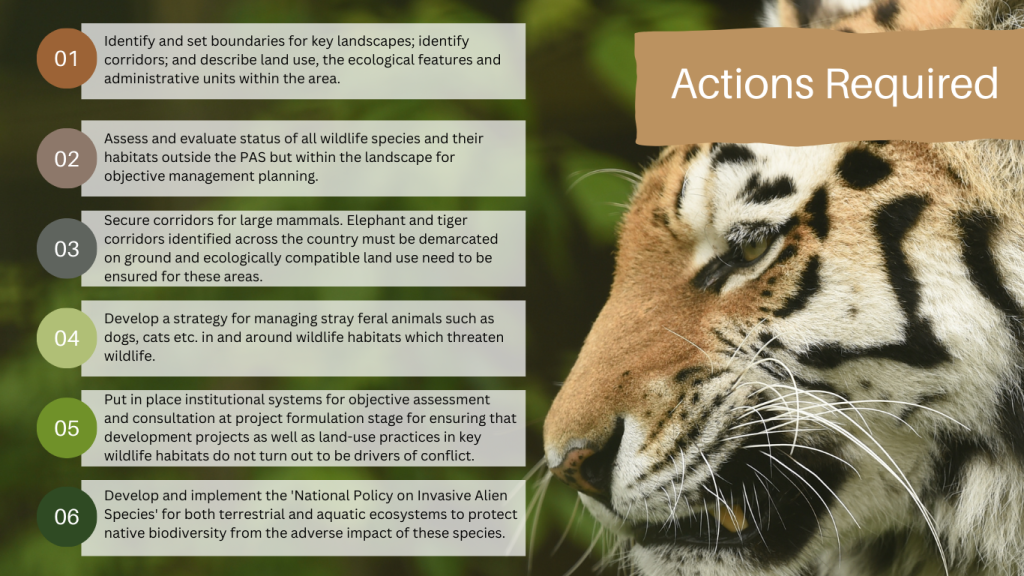
The plan suggests that the boundaries for key landscapes must be identified and land use, ecological features, and administrative units within the area must be defined. These must be used to create detailed land-use and land development maps of the identified landscapes, including not only reserve and revenue forests but also corridors that connect habitats within the landscape, especially those that connect protected areas with forests outside. Further, corridors used by large mammals such as tigers and elephants, which have been identified previously, must be “demarcated on ground” as the first step to ensure ecologically compatible land use across the corridors.
Management Plan for Wildlife Corridors
The NWAP provides specific guidelines and measures to secure wildlife corridors by improving corridor management, ensuring habitat restoration along corridors, minimizing human disturbances, promoting community participation, and incorporating landscape planning that considers the needs of wildlife movement. Foremost, the NWAP recommended that central guidelines be issued for preparing management plans for wildlife corridors and regulating land-use change in the identified corridors. These guidelines can be used by state forest departments to develop corridor management plans to prevent ecologically unsustainable activities in the area. The plan notes that wildlife areas in India are “largely interspersed with human habitations, power and irrigation related infrastructures, industrial estates and a variety of human activities.” Consequently, it explicitly states that corridor management plans should be prepared after active participation of different stakeholders. To ensure effective translation of plans into actions on ground, NWAP also suggests that the wildlife corridor plans must be integrated with the working plans or management plans of the state forest departments.
The status of all wildlife species and their habitats outside the protected areas but within the identified landscape must be assessed for objective management planning. Endemic and endangered species in need of conservation should be targeted for special recovery projects. In addition, the third NWAP identifies that a periodic review of the status of protected areas and corridors must be conducted every 10 years.
Integrating NWAP with Other Sectoral Programs
Given that protected areas are embedded in and several corridors are a complex mosaic of land-use that is often human-dominated, the participation and cooperation of different government sectors is imperative for landscape-scale conservation to succeed. The third plan identifies the need for an appropriate mechanism for ensuring effective coordination among various ministries, departments, and institutions. It also suggests that the idea of wildlife conservation should be integrated in the strategies, plans, and programmes of different sectors, including agriculture, fisheries, infrastructure, mining, petroleum, and tourism. For example, the plan suggests that the Ministry of Road Transport & Highways, Ministry of Railways, Ministry of Mines, Ministry of Coal, and Ministry of Petroleum & Natural Gas must address concerns about corridor connectivity during the planning stages of their projects. Consequently, they should adopt appropriate designs and technological solutions to mitigate the expected problems.
Education, Training, and Awareness of Managers and Forest Staff
In addition to direct management actions, the third NWAP also highlights the importance of education and training in long-term management of corridors. The existing mechanisms of recruitment, training, and career development of wildlife managers working in protected areas or territorial forests must be reviewed and revised. The frontline field staff must be equipped to protect wildlife by organizing training workshops, improving forensic support, and deploying modern technology for surveillance. For example, camera traps can be deployed in important corridors to protect the transient wildlife population. Moreover, the syllabi of various training and academic programmes, such as those offered by Wildlife Institute of India (Advanced Post Graduate Diploma, Certificate and Master of Science), must cover the full range of wildlife management, including management of corridors.
Conservation Under Changing Climate
What makes the third version of the NWAP unique is that this is the first time India has recognised the concerns relating to climate change impact on wildlife and stressed on integrating actions that need to be taken for the mitigation and adaptation of the impacts. For example, it calls for initiating a programme for assisted migration of wildlife, especially in highly fragmented landscapes and coastal areas where the impact of climate change may be more pronounced.
Tourism and Eco-development Projects Outside Protected Areas
The plan suggests that tourism potential should be explored outside protected areas, especially forested areas, safari parks, etc. As many of the forested lands outside protected areas in India are part of corridors, this suggestion can be indirectly associated with corridors. The revenue from tourism can be funneled back into wildlife management and community development. Previous NWAPs also suggested the use of eco-development in the management of protected areas. Eco-development is a multi-stakeholder and multi-disciplinary strategy that associates conservation value of a protected area with the livelihoods of surrounding communities. Per the third NWAP, eco-development projects should not be confined to tiger reserves, national parks, and wildlife sanctuaries but should be extended to other areas, including conservation and community reserves, recognized wildlife corridors, important wetlands, and elephant reserves. Notably, the plan also suggests that a feasibility study be conducted to assess the potential involvement of the private sector in conservation programmes within and outside protected areas.
Conclusion
The third NWAP recognizes the need to protect wildlife corridors and connect habitats at a landscape-level. Overall, the latest NWAP has expanded its scope to address contemporary challenges to wildlife conservation. By incorporating holistic strategies, involving various stakeholders, and recognizing the impact of changing climate, it strives to ensure long-term sustenance of wildlife. However, the future of wildlife will depend on how well this plan is implemented and how effectively it adapts to evolving environmental and socio-economic dynamics. Its success also relies on the commitment of implementing agencies, conservation organizations, and local communities to work collaboratively to safeguard wildlife beyond the protected areas.